A Bengaluru-based AI healthtech startup three months from launch has a model that performs strongly on its internal test set. The founders are confident; the lead engineer can rattle off AUROC, sensitivity, specificity, and calibration numbers. They are about to start hospital outreach. Their slide deck says “clinically validated.” Their first hospital meeting goes poorly because the medical director asks one question: “Validated by whom, on which patients, in which setting?”
The honest answer — “we held out 20% of our training data and tested on it” — is the answer the founders had not realised would be unacceptable. Six weeks later, they have not signed a single pilot. The product is good. The clinical validation case for it is not.
This is the most consistent failure pattern in Indian clinical AI healthtech in 2026. The technology is increasingly competent. The validation work is increasingly demanded. The gap between what founders mean by “validated” and what hospital procurement requires is wide, expensive to close, and usually underestimated.
What “Validation” Actually Means in 2026
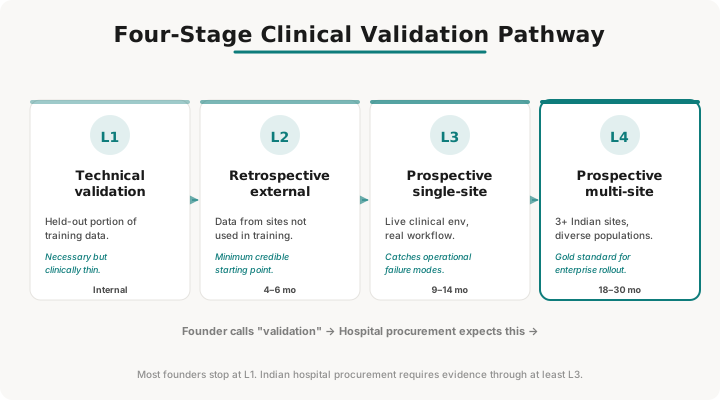
In clinical AI procurement conversations, validation has a specific structure with four distinct levels. Healthtech founders consistently conflate them.
Level 1: Technical validation. The model performs on a held-out portion of the training data. This is necessary but tells you very little. A model that performs well only on data drawn from the same source as training data has not been validated in any clinically meaningful sense.
Level 2: Retrospective external validation. The model is tested on data from one or more sites that were not part of training. This is the minimum credible starting point for hospital conversations. Performance typically drops compared to internal test — sometimes substantially — and the gap between the two numbers is itself informative.
Level 3: Prospective single-site validation. The model runs in a real clinical environment, on real prospectively-collected data, in workflow conditions. This is where many models that look good retrospectively reveal operational problems — latency, edge cases, integration friction — that affect clinical performance.
Level 4: Prospective multi-site validation. The model is tested across multiple Indian sites with different patient populations, scanner types, fixation protocols, or clinical practices. This is the gold standard and the level at which serious hospital procurement conversations become straightforward.
Hospital procurement teams in India in 2026 are increasingly aware of this hierarchy. Vendors who present Level 1 evidence as “validation” lose credibility quickly. Vendors with Level 3 evidence on at least one Indian site have a realistic procurement conversation. Vendors with Level 4 evidence on multiple Indian sites have meaningful leverage in pricing and pilot terms.
The Indian-Specific Validation Requirements
Validation done in Western populations does not automatically transfer to India. Three factors make Indian validation a distinct exercise:
Demographics and disease prevalence. Indian patient populations differ from US/European training cohorts on age distribution, comorbidity mix, and disease presentation patterns. A retinal screening model validated on a UK cohort will perform differently on an Indian cohort even before considering scanner variation.
Infrastructure variation. Indian hospitals run a heterogeneous mix of scanner manufacturers, lab equipment, and data systems. A model trained on cleanly-curated Stanford data may struggle on real-world data from a mid-size Indian hospital using older scanners and inconsistent imaging protocols.
Clinical practice variation. Documentation conventions, lab cutoffs, treatment patterns, and clinical decision points all shift between Western health systems and Indian ones. AI models built on Western workflow assumptions may produce outputs that look right but trigger the wrong clinical action.
ICMR has been actively developing guidance for clinical AI validation specific to Indian populations, and several institutional review boards are now operating with explicit AI-validation frameworks. Founders should anticipate that hospital partners and IRBs will ask India-specific questions, not generic ones.
Study Design: Practical Choices
A founder planning a serious clinical validation pathway faces several design decisions early. Getting them right saves substantial time and cost.
Retrospective vs prospective. Retrospective studies are faster and cheaper but face limitations on causality and workflow realism. Prospective studies are slower and more expensive but produce stronger evidence and clinical workflow data. The pragmatic path is usually: retrospective external validation first to establish baseline credibility, then prospective single-site, then prospective multi-site.
Single-site vs multi-site. Single-site validation answers “does this work here?” Multi-site validation answers “does this generalise?” Hospital procurement increasingly wants the latter. Multi-site validation is meaningfully harder logistically — site selection, IRB approvals, data sharing agreements, statistical adjustment for site effects — but the credibility gain is substantial.
Comparator selection. What is the AI being compared against? Standard-of-care clinician performance? A specific clinical scoring system? Historical baseline at the same site? Each comparator answers a different question and has different statistical demands. Vendors who do not have a defended comparator usually have not designed the study seriously.
Outcome definition. Validation of an AI tool’s prediction is one thing; validation of its impact on clinical outcomes is another. Procurement increasingly demands the latter, particularly for tools whose value proposition is improved clinical outcomes rather than improved workflow efficiency.
IRB and data governance. Indian IRBs vary in their familiarity with AI validation studies. Working with an IRB that has reviewed AI studies before is meaningfully faster than working with one for which yours is the first. Data sharing agreements with hospital partners are typically the slow step — start them three to six months before you need data flowing.
Realistic Timelines and Costs
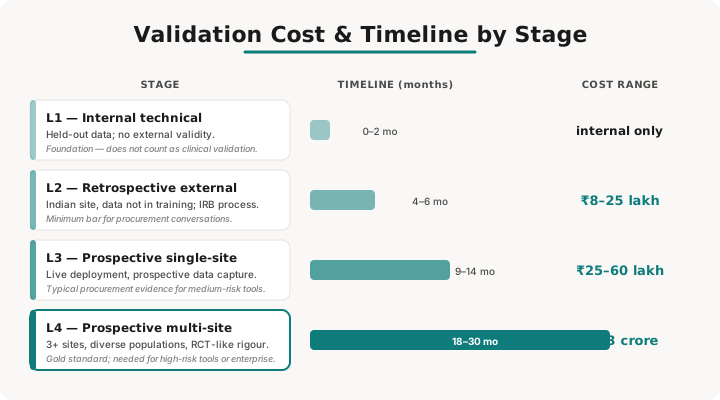
The single most-common founder mistake is underestimating timeline. Honest median timelines for each validation stage in Indian healthtech AI in 2026:
Level 2 (retrospective external validation, single site): 4–6 months from data agreement to publishable analysis. Cost ₹8–25 lakh depending on data complexity, statistical work, and IRB process.
Level 3 (prospective single-site validation): 9–14 months from study design to readout, including IRB, deployment, data collection, and analysis. Cost ₹25–60 lakh including study design, deployment, monitoring, and statistical analysis.
Level 4 (prospective multi-site validation across 3+ sites): 18–30 months from study design to readout. Cost ₹1–3 crore depending on site count, complexity, and study endpoints.
Founders who plan a 12-month commercial timeline assuming they will “do validation in parallel” almost always discover the validation work takes longer than the commercial work. The path that works is usually: start validation early — ideally before the GTM push — and treat validation as a multi-year investment rather than a launch checkpoint.
What Hospitals Will Actually Accept
The level of evidence required depends on what the AI tool does and what clinical decisions it influences.
Low-risk operational tools (e.g., AI scribes, workflow prioritisation): Level 2 evidence often sufficient. Hospital may proceed to pilot with retrospective validation and use the pilot itself to generate Level 3 data.
Medium-risk decision-support tools (e.g., AI radiology pre-read, AI ECG screening): Level 3 evidence typically required for procurement; Level 4 evidence required for enterprise-wide rollout.
High-risk clinical tools (e.g., autonomous diagnostic, treatment recommendation): Level 4 evidence required; CDSCO classification matters; clinical champions and named accountability owners required regardless of evidence.
Founders should map their tool to one of these tiers honestly and plan validation accordingly. The path of least resistance is usually to start with low-risk operational tools, accumulate clinical credibility and customer references, then expand into higher-risk applications.
A Pragmatic Path
For a healthtech founder starting validation work in 2026, the path that consistently produces commercial outcomes:
- Commission a Level 2 retrospective external validation with a credible Indian academic partner before public launch. Total time: 6 months. Cost: ₹15–25 lakh.
- Use Level 2 data to secure paid Level 3 prospective pilots at 1–2 commercial hospital partners. Document validation continuously during pilot.
- Extract Level 3 evidence from successful pilots, ideally with publication in an Indian peer-reviewed journal. Use this for next-tier hospital sales.
- Plan Level 4 multi-site validation as a 24-month parallel track, funded by commercial revenue from Level 3 traction.
This is slower than founders typically want and faster than skipping validation entirely. It is the path that produces both clinical credibility and commercial scale.
Further Reading
Authoritative references
- Indian Council of Medical Research (ICMR): clinical research and validation guidance for AI studies on Indian populations.
- CDSCO India — Medical Devices and SaMD: regulatory pathway for AI medical device classification.
- EQUATOR Network: TRIPOD-AI, CONSORT-AI and reporting guidelines that inform study design.
- Ayushman Bharat Digital Mission (ABDM): integration context for validation studies that involve ABDM-routed data.
- NABH — National Accreditation Board for Hospitals: accreditation standards relevant to validation sites.
- PubMed: primary literature index for clinical AI validation studies and reporting standards.
Related perspectives from MedAI Collective
- Selling Clinical AI to Indian Hospitals — A Founder’s GTM Playbook
- Types of Clinical Data — A Practical Taxonomy for AI Projects
- Unstructured and Missing Data in Clinical AI
- Sandbox Testing for Clinical AI: A Practical Guide
- How to Evaluate a Clinical AI Tool — A Doctor’s Framework
- Browse all perspectives
If you are a healthtech founder planning a clinical validation roadmap or evaluating an existing study design, MedAI Collective Consulting works with founders on validation strategy, site selection, and study design.