Most clinical AI startups in India do not die because their model is wrong. They die because the journey from a working model to a paying hospital customer turns out to be twelve to eighteen months longer than the founder budgeted, involves four buyers no one warned them about, and ends with a pilot extension that nobody pays for. The technology is necessary. It is rarely sufficient.
This article is a practical GTM playbook for clinical AI founders selling into Indian hospitals — based on observed patterns from healthtech companies that have scaled successfully and the more numerous ones that have not. It will not tell you how to build a model. It will tell you how to navigate everything that happens after.
The Buyer Map Is Five People, Not One
The first mistake most founders make is selling to a champion. The champion — usually a senior consultant in the relevant specialty — will tell you the tool is excellent, that they want it deployed next month, and that they will introduce you to the right people. Six months later you are still waiting for those introductions because the champion does not actually own the procurement decision.
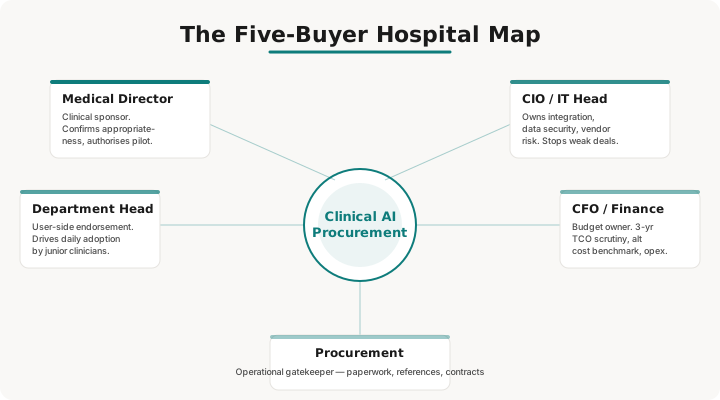
In a 200-bed Indian multi-specialty hospital, the buyer map is approximately five people:
The Medical Director or CMO is the clinical sponsor. They confirm the tool is appropriate for their clinical environment and authorise the pilot. Without them, the deal does not start. With them alone, the deal does not close.
The CIO or IT Head owns integration, data security, and infrastructure decisions. In mid-size hospitals, this person is often skeptical of new vendors because the existing IT environment is already strained. They will ask hard questions about data residency, integration, and ongoing support. If your answers are unconvincing, the deal stops here regardless of how much the medical director wants the tool.
The CFO or Director of Finance owns the budget. They will ask about TCO over three years, who else is using the tool, what the alternative cost is, and how the tool fits into the operating budget cycle. Most clinical AI tools are sold as subscriptions, which means the CFO is also the renewal decision-maker.
The Department Head is the daily user-side stakeholder — head of radiology for an imaging AI, head of cardiology for an ECG tool, head of medicine for a clinical decision support tool. Without their endorsement, junior doctors will not use the tool. With it, even imperfect tools get adopted.
Procurement is the operational gatekeeper. They will ask for documentation, vendor references, financial stability proof, and contract amendments. They are not the decision-maker, but they can stall a deal indefinitely with paperwork requests if they have not been brought in early.
The deal closes when all five align. The deal stalls when any one of them is unaddressed. Most founder time is spent on the medical director and the department head; most deal slippage comes from the CIO, CFO, and procurement.
The Pilot Is the Sale
There is no “evaluation, then sale” in Indian hospital AI procurement. There is a pilot, and the pilot becomes the sale. Pilots that go well close. Pilots that drift end. Pilots that produce ambiguous results turn into pilot extensions that do not close.
This means the pilot must be designed as a sales asset from day one.
Pre-define success criteria with the customer. Before the pilot starts, agree in writing what “success” means. Three to five quantitative metrics, one to two clinician-experience metrics, and a clear definition of the threshold above which the customer commits to procurement. Pilots without pre-defined success criteria almost never convert; success becomes whatever each stakeholder wants it to mean, and the stakeholders disagree.
Make the pilot small and short. Sixty to ninety days, one department, one specific use case. Pilots that try to demonstrate the full product across multiple departments produce diffuse results and cannot be analysed cleanly.
Plan the integration burden honestly. Most pilots fail not on the AI performance but on the integration friction — connecting to the HIS or PACS, getting clinician accounts created, training users. Budget twice as much pilot setup time as the engineering team estimates, and have a dedicated implementation lead, not a part-time engineer.
Capture data the customer cares about, not just the data you find interesting. A radiology AI vendor running a pilot may want detection sensitivity. The radiology head wants to know whether the tool reduces report turnaround time. Both metrics matter; the customer-facing one is what closes the deal.
The Validation Question Will Not Go Away
Indian hospitals are increasingly aware of the validation gap in clinical AI. The questions that came up rarely in 2022 — “Was your model trained on Indian data?” “Do you have local validation?” “Has CDSCO reviewed this?” — are now standard in every serious procurement conversation in 2026.
Founders without good answers to these questions face a hard ceiling on hospital sales.
Indian validation data is not optional any more. Models trained primarily on Western data and validated on small Indian cohorts can sell, but they sell harder, longer, and at lower price points than tools with substantial Indian validation. If your validation strategy is “we trained on Stanford data and showed similar metrics on a sample from one Mumbai hospital,” that will not survive the medical director’s questions.
Plan validation as a multi-site, multi-quarter project. A single pilot at a single hospital is not validation; it is a deployment. Validation requires demonstrating model performance across multiple Indian patient populations, ideally at sites differing in geography, demographics, and clinical practice. This is not a marketing exercise; it is the foundation of clinical claims you can defensibly make.
Be ready for CDSCO and ABDM questions. Where your tool sits in CDSCO’s evolving software-as-a-medical-device framework matters to procurement. Whether your tool integrates with ABDM matters to forward-looking hospitals. You do not need to have every answer; you need to have credible plans.
Pricing That Indian Hospitals Will Actually Pay
Pricing for clinical AI in Indian hospitals does not work the way it does in US health systems, and founders who anchor on US pricing produce stuck deals.
The pricing models that close in 2026 fall into three patterns:
Per-study or per-scan pricing, particularly for radiology and pathology AI. Hospitals understand this model from existing teleradiology billing. It is operationally manageable and scales with use. Typical ranges in 2026 are ₹40–₹250 per study depending on complexity and competition.
Per-bed annual licence, particularly for hospital-wide tools like clinical decision support or AI scribes. Hospitals understand this from EMR pricing. Typical ranges are ₹2,000–₹15,000 per bed per year depending on the depth of the tool and the size of the hospital.
Outcomes-aligned pricing, where part of the fee is contingent on a measurable outcome — reduced length of stay, improved screening detection, reduced report turnaround. These deals are operationally complex and only work with sophisticated counterparty hospitals. They produce the deepest customer commitment when they work.
The pricing model that does not work in most mid-size Indian hospitals is high-fixed-fee SaaS pricing on US benchmarks. A $50,000-per-year tool with no usage tier prices itself out of the segment that constitutes most of Indian healthcare.
A Realistic Timeline
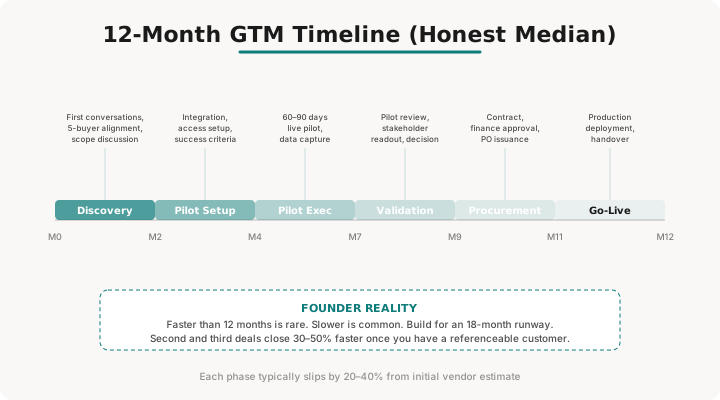
If you are a founder budgeting GTM resources, the honest median timeline from first conversation with a hospital to a paid, in-production deployment is 12 months. Faster than this is rare. Slower than this is common.
The implication for founder strategy: start more conversations than you think you need, expect a long pipeline build, and design the company’s burn rate to survive 18 months of commercial development before predictable revenue arrives. Founders who build for a six-month sales cycle run out of runway in month nine.
The good news is that once a clinical AI tool is in production at one hospital, the second and third deals close meaningfully faster — referenceable customers in Indian healthcare are extremely valuable, and the operational lessons from the first deployment compress later ones. The bad news is that the first deal, the one that unlocks everything else, is the longest and hardest one.
This is the part of clinical AI GTM that the technology cannot shorten. The founders who succeed are the ones who plan for it.
Further Reading
Authoritative references
- CDSCO India — Medical Devices and SaMD: regulatory pathway every clinical AI startup must understand before commercial launch.
- Ayushman Bharat Digital Mission (ABDM): national digital health stack — ABDM compatibility is a buying-criterion for forward-looking hospitals.
- Indian Council of Medical Research (ICMR): clinical research and validation guidance for medical-device-classified AI tools.
- Ministry of Electronics and IT — DPDP: India’s data protection framework, governing how vendors handle hospital and patient data.
- NABH — National Accreditation Board for Hospitals: Indian hospital accreditation; understanding what NABH expects helps founders position for procurement conversations.
- HL7 FHIR: integration standard your AI tool will need to speak to land in modern hospital IT environments.
Related perspectives from MedAI Collective
- ABDM 3.0: New Interoperability Rules Explained
- AI Clinical Decision Support: What Works in Indian Hospitals
- Types of Clinical Data — A Practical Taxonomy
- AI Readiness Checklist for 100–300 Bed Hospitals in India
- How to Evaluate a Clinical AI Tool — A Doctor’s Framework
- ABDM Sandbox: A Doctor’s Guide to Testing AI Integrations
- Browse all perspectives
If you are building clinical AI for Indian hospitals and need a sounding board on GTM strategy, validation roadmap, or pricing model, MedAI Collective Consulting works with healthtech founders on exactly these questions. Founders can also browse our perspectives library for sector-specific guides referenced through this article.