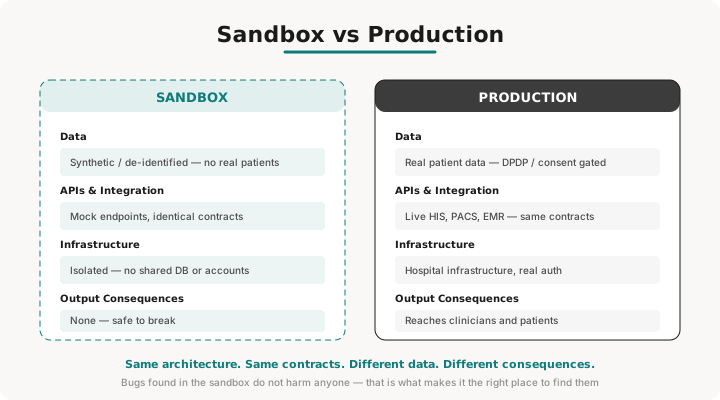
Software engineering has a concept that does not yet have a stable equivalent in clinical AI procurement conversations: the sandbox. A sandbox is an isolated environment that mimics production — same data structures, same APIs, same workflow integration points — but with synthetic or de-identified data and no path to real patients. Code runs there before it runs in production. Bugs found in the sandbox do not harm anyone.
For clinical AI, the sandbox is more than a technical detail. It is the space where a tool’s behaviour can be examined without clinical risk, where edge cases can be probed without consent complications, and where integration problems can be found before patient care depends on them. A clinical AI tool that has not been through proper sandbox testing should not be in production. A vendor who cannot explain their sandbox approach has not thought carefully enough about clinical safety.
This article is a practical guide to sandbox testing for clinical AI — what it means, why it matters, and the layers every credible tool should pass through before live deployment.
What a Sandbox Actually Is
The term sandbox is used loosely. In a clinical AI context, it has a specific structure worth understanding.
A sandbox environment has three properties that production does not.
Synthetic or de-identified data. No real patient data passes through the sandbox. Either fully synthetic data is generated to match the structure and statistical properties of real clinical data, or de-identified historical data is used under a data-sharing agreement that allows testing use only.
Isolated infrastructure. Sandbox systems do not share databases, accounts, or network paths with production. A failure in the sandbox cannot cascade into production. A bug that processes incorrectly in the sandbox does not affect any real workflow.
No clinical consequences. Output from a sandbox does not reach a clinician’s screen, an EMR, or a patient. Nothing the sandbox produces can be acted on. This is the property that makes the sandbox safe to break.
A “sandbox” that lacks any of these three properties is not a sandbox; it is a less polished version of production with extra risk. Clinicians evaluating vendors should ask explicitly which of the three properties applies to the testing environment the vendor uses.
Why Sandbox Testing Matters Clinically
The temptation, particularly for early-stage clinical AI vendors, is to skip directly to a clinical pilot. The model works in the lab, the integration is straightforward, the customer is willing — why introduce a sandbox layer that delays the timeline?
The answer is that several categories of failure are essentially invisible in the lab and only emerge in something resembling production. A sandbox catches them; a clinical pilot catches them as well, but with a real patient in the loop.
Edge case behaviour. Lab evaluation typically runs the model on a curated test set. The sandbox can run it against the full distribution of real-shape data — including rare cases, malformed inputs, missing fields, and data combinations that did not appear in any test set. Edge case failures discovered here are inconvenient. Discovered in clinical pilot, they are dangerous.
Integration friction. Lab evaluation often does not exercise the full integration path — the model takes input from a file rather than from the EMR, produces output to a CSV rather than to a clinician’s interface. The sandbox runs the model with the actual integration points. Problems that emerge here — latency, payload format mismatches, authentication issues, error handling — are nearly always present and easier to fix in the sandbox.
Stress behaviour. Real clinical environments produce data at variable rates. A sandbox can simulate peak load, intermittent connectivity, and concurrent users. These conditions are where many clinical AI tools degrade badly, and where clinical impact is highest because they correspond to the busy clinical situations that needed the tool most.
Failure mode behaviour. When the model is uncertain, when input data is unusual, when an upstream system fails — what does the tool do? Sandbox testing explicitly probes these conditions. A tool that fails silently in the sandbox will fail silently in production; the difference is that the sandbox shows you, while production shows the patient.
The Four Testing Layers
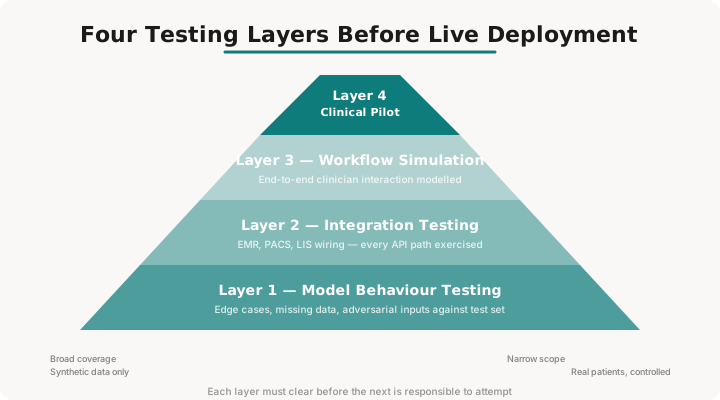
A credible clinical AI development cycle includes four sandbox testing layers, in order. Each layer answers a different question.
Layer one: model behaviour testing. Does the model produce correct output on a comprehensive test set, including edge cases, missing data, and adversarial inputs? This layer is closest to traditional ML evaluation but expanded to cover failure modes, not just average accuracy. The output is a behavioural specification for the model — a list of inputs and corresponding expected outputs that should hold across model updates.
Layer two: integration testing. Does the model behave correctly when wired into the systems it will use in production — the EMR, the PACS, the LIS, whatever applies? Integration testing in a sandbox exercises every API call, every data transformation, every error path. It is the layer where most clinical AI deployments hit unexpected problems, and where catching them is cheapest.
Layer three: workflow simulation. Does the tool behave correctly within the full clinical workflow it is meant to support? This means simulating a clinician’s interaction with the tool — login, patient selection, data entry, AI output review, action — and checking that each step works as designed. Workflow simulation often reveals that a model that performs well in isolation creates frustration in workflow.
Layer four: clinical pilot. Only after the previous three layers have been cleared does the tool earn the right to a controlled clinical pilot with real patients, real clinicians, and real consequences. The clinical pilot is not a substitute for sandbox testing; it is what the sandbox testing makes safe.
Common Failures to Probe in the Sandbox
If you are designing or evaluating sandbox testing for a clinical AI tool, the following failure modes deserve explicit testing. They are the ones that recur most across deployments.
Distribution shift. The model was trained on data from one population; the sandbox provides data from another. How does performance change? Does the tool quietly degrade or does it flag the shift? Tools that do not detect when their input is unfamiliar are dangerous in clinical use.
Missing or partial data. Real clinical data is missing fields, has out-of-range values, or arrives partially. Sandbox testing should run the tool against deliberately incomplete inputs and check the response. Reasonable responses include explicit error, low-confidence output, or graceful degradation. Unreasonable responses include silent fabrication or confident incorrect output.
Concurrent and high-load conditions. Sandbox load testing reveals where latency degrades, where queues back up, and where errors emerge under stress. Clinical workflows do not slow down to accommodate a tool that struggles at peak hours.
Authentication and authorisation edge cases. What happens when a clinician’s session expires mid-use? What happens when a tool tries to access a patient record outside the user’s permission scope? Many clinical AI tools fail badly here in ways that are nearly impossible to discover without deliberate sandbox testing.
Update behaviour. When the model is updated, what happens to in-flight workflows? Does behaviour change without notification? Are there compatibility breaks? Production model updates are a major source of clinical AI incidents; sandbox testing should rehearse them.
Five Questions for Vendors
If you are a clinician, hospital administrator, or procurement lead evaluating a clinical AI tool, the questions below surface most of what matters about the vendor’s sandbox practice.
First, describe your sandbox environment. A vendor who cannot describe their sandbox in concrete terms — what data, what infrastructure, what isolation — does not have a meaningful sandbox.
Second, what failure modes have you tested against in sandbox? A list of two or three is unacceptably small; a list of fifteen to thirty is what serious clinical AI development looks like.
Third, how is your sandbox different from your production environment? The differences should be specific and small. A sandbox that diverges substantially from production is testing something other than the production system.
Fourth, how do you handle synthetic or de-identified data in your sandbox? Especially relevant for tools that need rich clinical data — generating realistic synthetic data that exercises edge cases is non-trivial.
Fifth, what testing happens between sandbox and clinical pilot? A direct jump from sandbox to live patient use is a red flag. Most credible deployment paths include a shadow mode — the tool runs against real data but its output is not shown to clinicians — before full live deployment.
A Note on Regulatory Sandboxes
Several countries operate regulatory sandboxes for healthcare AI — environments where vendors can test integration with national health data systems before full deployment. India’s ABDM sandbox is one example; the UK’s MHRA and the FDA’s pre-certification and digital health programs offer conceptually related sandboxes. These regulatory sandboxes are valuable but they are not substitutes for the vendor’s own sandbox practice. They test compliance with national standards; they do not test clinical safety, integration robustness, or workflow fit.
A complete clinical AI testing approach uses both — the vendor’s sandbox for clinical and integration safety, the regulatory sandbox for system compliance, and the clinical pilot only after both have been cleared.
The discipline is not exciting. It does not appear in product demos. It is, however, the difference between a clinical AI tool that earns trust over years and one that produces a high-profile failure that sets the entire category back. For clinicians, hospital leaders, and founders alike, sandbox practice is one of the clearest signals of how seriously a tool’s developers take clinical safety.
Further Reading
Authoritative references
- FDA — Digital Health Center of Excellence: the US FDA’s framework for software-as-medical-device, pre-certification, and AI/ML-enabled devices.
- MHRA UK — Medicines and Healthcare products Regulatory Agency: the UK regulator with active AI Airlock and sandbox programs for healthcare AI.
- CDSCO India: India’s medical device regulator, relevant for any clinical AI tool seeking domestic market entry.
- ABDM Sandbox: India’s national digital health sandbox for testing healthcare integrations.
- HL7 FHIR: the data interchange standard sandbox testing must validate against.
- EQUATOR Network: TRIPOD-AI, CONSORT-AI and reporting guidelines that inform sandbox test design.
- WHO — Ethics and Governance of AI for Health: governance principles that inform safety-first sandbox practice.
Related perspectives from MedAI Collective
- How to Evaluate a Clinical AI Tool — A Doctor’s Framework
- AI Foundations for Clinicians
- ABDM Sandbox: A Doctor’s Guide to Testing AI Integrations
- Types of Clinical Data — A Practical Taxonomy for AI Projects
- Unstructured and Missing Data in Clinical AI
- Selling Clinical AI to Indian Hospitals — A Founder’s GTM Playbook
- Browse all perspectives
For founders and clinical teams designing sandbox practice for new AI tools, MedAI Collective Consulting provides structured testing frameworks tailored to specific use cases and integration profiles. Hospital teams evaluating vendor sandbox claims can engage MedAI Collective Advisory for vendor-neutral assessment support.