A 250-bed multi-specialty hospital in Pune signed up for an AI radiology tool eighteen months ago. The procurement was driven by the head of radiology, who wanted faster turnaround on plain films. The CFO approved a one-year licence at ₹18 lakh, fully expecting to renew if the tool delivered. The licence is now up for renewal. The radiology head reports the team likes the tool. The CFO has asked one question and asked it three times in a row: what did we get for the eighteen lakh?
The answer the radiology team has offered — faster reads, happier clinicians, a feeling that workflow has improved — is true. It is also not what the CFO is asking. The CFO is asking for a structured ROI argument that can be defended in the next board meeting and used as a precedent for the next AI procurement. Without that argument, the renewal is not a foregone conclusion regardless of clinician sentiment.
This article is a practical framework for clinical AI ROI in Indian hospitals — what the five categories of return actually look like, which KPIs matter, what gets measured in practice, and three worked examples that map to the most common Indian deployments.
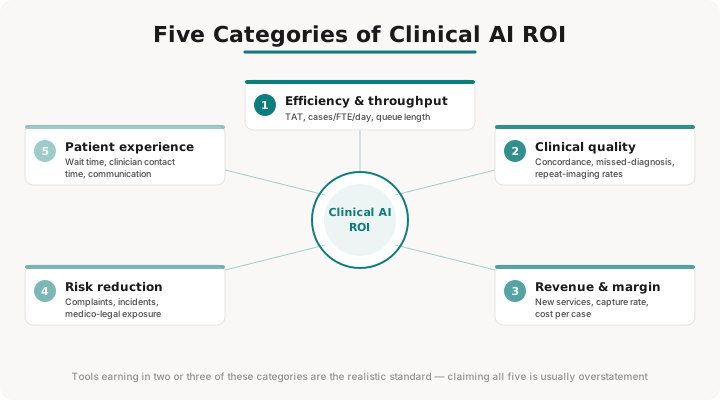
The Five Categories of Return
Clinical AI ROI in Indian hospitals falls into five practical categories. A tool that does not deliver measurably in at least two of these does not justify a renewal at scale.
Efficiency and throughput. Faster turnaround time, more cases handled per clinician per day, reduced backlog, shorter report-to-action time. This is the most measurable category and where most AI radiology, AI scribe, and AI screening tools earn their ROI. KPIs are straightforward: report turnaround time, cases per FTE per day, queue length.
Clinical quality. Improved diagnostic accuracy, reduced missed-diagnosis rates, more consistent grading, fewer follow-up errors. This category is genuinely valuable but operationally harder to measure — the comparator is what would have happened without the AI, which is rarely captured cleanly. Useful proxies include peer-review concordance rates, repeat-imaging rates, and second-opinion request rates.
Revenue and margin. New revenue lines (expanded screening services, faster bed turnover enabling more admissions), improved capture rates (better coding, fewer missed billable services), or margin improvement through reduced cost per case. This is where finance teams are most receptive but where many AI vendors most overstate. Calculations need to be conservative.
Risk reduction. Reduced malpractice exposure through better documentation, fewer missed time-critical diagnoses, improved compliance posture. Hard to measure directly; usually captured through proxies like complaint rates, incident reports, and medico-legal exposure.
Patient experience. Faster results, more time with the clinician (because the AI freed it up), better communication. This is real but typically hardest to monetise in the Indian hospital context. It matters most when it translates to retention or referral, which in India often runs through individual clinician reputation more than through hospital systems.
A vendor pitching all five categories with confident numbers is usually overstating; one earning in two or three categories with conservative numbers is usually credible.
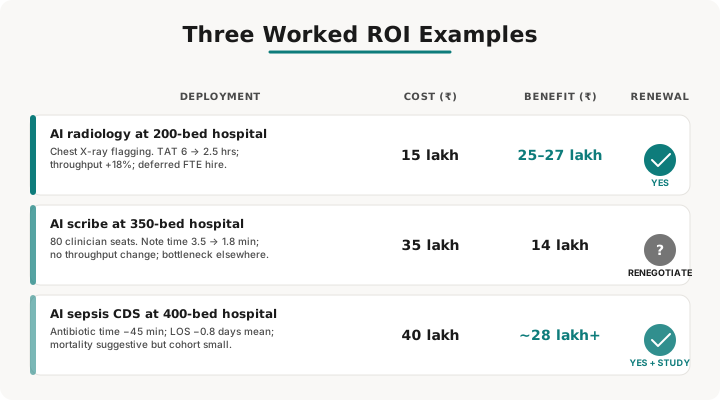
Three Worked Examples
The abstract framework is more useful with concrete examples. Three patterns recur in Indian deployments.
Example 1: AI radiology tool at a 200-bed multi-specialty hospital. Annual licence ₹15 lakh. Tool reads chest X-rays, flagging high-priority findings for radiologist attention. After 12 months: report turnaround time dropped from 6 hours mean to 2.5 hours mean. Critical findings flagged faster, with two documented cases of time-critical diagnoses caught more quickly than likely would have been without the tool. Radiologist throughput increased by approximately 18% on plain films, enabling the team to absorb a 12% volume growth without adding FTE. ROI argument: throughput improvement saved approximately ₹22 lakh in deferred hire cost; faster critical findings argued for ₹3–5 lakh equivalent risk reduction. Total quantified benefit ~₹25–27 lakh against ₹15 lakh cost. Renewal: clear yes.
Example 2: AI scribe deployed across OPD at a 350-bed hospital. Licence ₹35 lakh annually for 80 clinician seats. Tool listens to patient consultations and produces structured notes. After 9 months: average consultation note time dropped from 3.5 minutes to 1.8 minutes post-encounter. Clinician satisfaction up. However, OPD throughput did not change meaningfully because the bottleneck was patient scheduling, not documentation. Documentation completeness improved (more structured fields populated), but coding revenue impact was minimal because the hospital was not undercoding before. ROI argument: clinician time saved approximately ₹14 lakh equivalent in value, but no throughput or revenue gain. Renewal: conditional on price renegotiation.
Example 3: AI clinical decision support for sepsis at a 400-bed hospital with active ICU. Annual licence ₹40 lakh. Tool monitors patients and produces early sepsis warnings. After 12 months: time-to-antibiotics in flagged patients improved by approximately 45 minutes mean. ICU length of stay for sepsis cases decreased modestly (0.8 days mean). Mortality benefit was suggestive but the cohort size was too small for definitive claims at one year. ROI argument: LOS reduction saved approximately ₹28 lakh in bed-day costs; faster antibiotic time argued for both quality and risk benefit. Renewal: yes, with multi-year validation plan to firm up mortality claim.
These three examples show the pattern. The tools that renew are the ones where the ROI argument is concrete, conservatively stated, and traceable to specific KPIs. The tools that do not renew are not necessarily clinically bad — they often lack a defensible ROI story even when clinicians like them.
What CFOs Should Actually Demand
A hospital CFO evaluating a clinical AI renewal — or a new procurement — should require the following documentation before approving spend:
A baseline measurement from before the tool was deployed. Without this, every ROI claim is unfalsifiable. The baseline should include the KPIs the tool is expected to move and be measured in the same way pre- and post-deployment.
A short-list of two to four specific KPIs the tool is expected to improve. Tools claiming to improve everything usually improve nothing measurably. Specificity is a quality signal.
A monthly tracking report showing KPI trajectory against baseline. This converts the ROI argument from anecdote to data. If the vendor cannot produce this — or the hospital cannot — the renewal conversation lacks the input it requires.
A worst-case scenario. What happens if the tool is turned off tomorrow? If the answer is “nothing measurable changes for six weeks,” the tool may be less valuable than the licence suggests.
A three-year total cost projection. Not just the licence — implementation, ongoing IT support, infrastructure, training, and renewals. AI tools are operating expenses for their full lifetime.
The Reality of First-Year ROI
A specific point worth being honest about: most clinical AI deployments do not show clean positive ROI in year one. Year one includes implementation effort, clinician learning curve, workflow disruption, and IT integration costs that subsequent years do not. Year two is when the ROI argument typically becomes defensible. Year three is when scale benefits compound.
Hospitals that procure on a one-year horizon with year-one ROI expectations will either be perpetually disappointed or will avoid AI investment that would have paid off. The realistic frame is: pilot for 6–9 months with explicit success criteria, sign a two- to three-year licence on success, and expect cumulative ROI to compound from year two onwards.
This is the conversation the CFO and the medical director should be having before the first procurement. Once the tool is signed at one-year horizon expectations, the ROI argument is structurally harder to make.
Further Reading
Authoritative references
- WHO — Digital Health: global frameworks contextualising clinical AI economic evaluation.
- Ayushman Bharat Digital Mission (ABDM): infrastructure context for hospitals running clinical AI tools.
- NABH — National Accreditation Board for Hospitals: accreditation standards relevant to clinical quality KPIs.
- Indian Council of Medical Research (ICMR): research and validation guidance for clinical AI claims.
- PubMed: peer-reviewed clinical AI economic and effectiveness literature.
Related perspectives from MedAI Collective
- AI Readiness Checklist for 100–300 Bed Hospitals in India
- AI Clinical Decision Support: What Works in Indian Hospitals
- Why Radiology AI Works in Tier 1 Hospitals But Stalls Everywhere Else
- Selling Clinical AI to Indian Hospitals — A Founder’s GTM Playbook
- How to Evaluate a Clinical AI Tool — A Doctor’s Framework
- Browse all perspectives
If your hospital is preparing a clinical AI renewal review or building a business case for a new procurement, MedAI Collective Consulting works with hospital CFOs and medical directors on structured ROI frameworks and renewal decisions. Hospital leadership teams can also join an upcoming Practitioner Briefing for vendor-neutral guidance.