AI clinical decision support tools are arriving in Indian ICUs and OPDs before the doctors expected to act on their outputs understand what those outputs actually mean — or when to question them. This is not a criticism of the tools themselves, many of which are genuinely useful when deployed with appropriate governance. It is a description of the implementation gap that currently defines AI adoption in Indian hospitals: technology moving faster than clinical comprehension, vendor enthusiasm outpacing institutional readiness, and individual doctors left to calibrate their trust in probabilistic outputs without any formal framework for doing so.
The stakes are not abstract. A doctor who treats a 72% sepsis risk score as a definitive diagnosis is making a fundamentally different kind of error than one who ignores it entirely. Both responses are wrong, but in different ways, and for reasons that only become clear once the nature of the output is understood. Clinical decision support, in its AI-driven form, is asking something genuinely new of doctors: not a simple binary yes or no, but a probabilistic judgment about a probabilistic input, made in real time, under conditions of uncertainty, with full clinical accountability resting on the human rather than the algorithm.
Understanding what these tools actually are, where they are already operating in Indian healthcare, and how to use them without either over-trusting or systematically ignoring them is now a core clinical competency — not a technology elective.
What Clinical Decision Support Is — and What AI Changes About It
Clinical decision support systems are not new. Rule-based CDSS has existed in various forms for decades: drug interaction checkers that flag when two prescribed medications are contraindicated, dosing calculators that adjust for renal function or paediatric weight, structured reminders that alert a prescriber when a patient’s documented allergy is inconsistent with a new prescription. These tools are deterministic. They operate on explicit rules: if condition A and condition B, then alert C. The logic is transparent, the trigger is knowable, and the override decision is relatively straightforward. A doctor who sees a penicillin allergy alert and proceeds anyway does so with clear awareness of what they are overriding and why.
Machine learning-based CDSS changes the fundamental character of this interaction. Rather than applying explicit rules, an ML model learns statistical associations from large datasets and generates probabilistic outputs — risk scores, classification probabilities, predicted outcomes — that reflect patterns the model has detected but cannot always articulate. The output is no longer “this drug is contraindicated” but “this patient has a 68% probability of clinical deterioration in the next six hours.” The WHO’s guidance on AI in health explicitly identifies this shift from rule-based to learning-based systems as one that requires new frameworks for clinical governance and accountability.
This is not a marginal technical distinction. It changes what the doctor is being asked to do with the output. In rule-based CDSS, the doctor is being asked to confirm or override a specific flag derived from a known rule. In ML-based CDSS, the doctor is being asked to integrate a probabilistic estimate — generated by a model whose internal workings are not transparent, trained on data that may or may not resemble their patient population — into a clinical judgment they will be fully accountable for. The cognitive and epistemic demands are categorically different, and the clinical training that prepared doctors for the first task did not specifically prepare them for the second.
The Three Categories of AI Clinical Decision Support
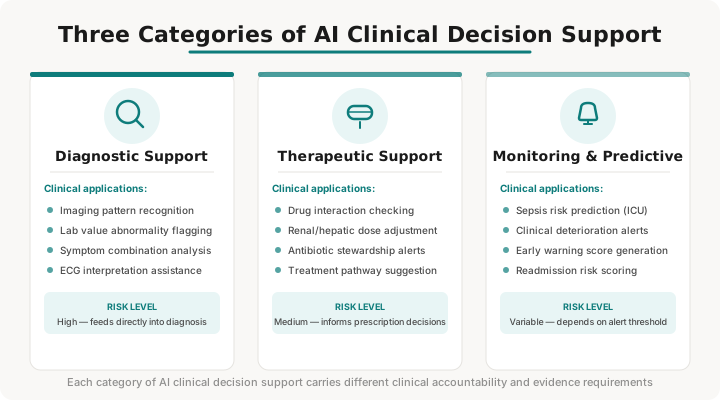
AI-based CDSS tools generally fall into three functional categories, each with different clinical implications, different evidence bases, and different risk profiles.
Diagnostic support tools use pattern recognition to assist with clinical diagnosis. These include imaging AI (radiology, pathology, dermatology) that flags abnormalities or classifies findings, as well as tools that analyse symptom combinations, laboratory results, or clinical notes to generate differential diagnosis suggestions. The performance of diagnostic AI tools is typically reported in terms of sensitivity, specificity, and AUC — metrics that, as discussed in the evaluation framework at doctors-framework-evaluating-ai-tools.html, must be interpreted in the context of the population in which the tool was validated, not assumed to transfer directly to every clinical setting.
Therapeutic support tools assist with decisions about treatment, including drug selection, dosing, interaction checking, and treatment pathway guidance. These range from relatively low-risk tools (automated dose adjustment recommendations based on renal function) to higher-stakes applications (treatment selection guidance in oncology or antimicrobial stewardship). The quality of evidence supporting these tools varies significantly, and the distinction between a recommendation tool and a prescribing tool has important regulatory implications.
Monitoring and predictive tools are deployed primarily in high-acuity settings — ICUs, emergency departments, high-dependency units — where early warning scores, sepsis prediction algorithms, and deterioration alerts operate continuously on streaming patient data. The Surviving Sepsis Campaign has contributed to international awareness of the clinical stakes involved in delayed sepsis recognition, and AI-based sepsis prediction is among the most actively deployed categories of clinical AI in Indian tertiary hospitals. These tools are high-value when calibrated well and actively harmful when generating alert fatigue that causes genuine alerts to be ignored.
Where AI-Based CDSS Is Active in Indian Hospitals
Characterising the actual deployment landscape of AI clinical decision support in Indian hospitals requires care. There is a meaningful gap between what is piloted, what is deployed in limited settings, and what is in routine clinical use at scale. Vendor claims routinely conflate these categories; hospital press releases are not validation evidence.
With that caveat, several areas of genuine deployment can be identified. Sepsis prediction algorithms are operational in the ICUs of several large Indian hospital chains, running on streaming vital sign and laboratory data to generate early warning alerts for clinical deterioration. Drug interaction checking is embedded in outpatient prescribing platforms including Healthplix, which is used across a significant number of private practice settings in India, as well as in pharmacy management software at major hospital chains. These tools operate largely in the background and are, in that sense, the category of AI CDSS that Indian doctors are already using without necessarily thinking of them as AI.
Laboratory value flagging with ML-generated risk tiers — where a lab report is annotated not just with the raw value and reference range but with a risk classification derived from the patient’s full laboratory history — is a more recent development, piloted in some large diagnostic networks. The clinical utility depends heavily on whether the flagging is integrated into the doctor’s primary workflow or delivered as a separate annotation that requires active attention.
ICMR has identified clinical AI tools as a priority research and regulatory focus, and is engaged in developing validation frameworks for AI-based medical devices, a category that includes most CDSS products once they move from general wellness to clinical recommendation territory. The broader deployment landscape for AI in Indian hospitals is covered in detail at ai-for-doctors.html.
The Alert Fatigue Problem — and Why ML-Based CDSS Makes It Worse
Alert fatigue is not an AI problem; it predates machine learning in clinical settings by decades. The documented pattern across healthcare systems that have implemented rule-based CDSS is that physicians override the majority of clinical decision alerts when alert frequency is high — not because the alerts are wrong, but because the signal-to-noise ratio becomes so poor that systematic review of every alert is not cognitively feasible in clinical practice. Studies across multiple healthcare settings have consistently found that override rates for rule-based drug interaction alerts exceed 70-90% in high-volume prescribing environments. This is not clinician negligence; it is a rational adaptive response to an overwhelming volume of low-specificity signals.
ML-based CDSS creates a different version of the same problem, and in some ways a harder one. The outputs are not simple binary flags but probabilistic scores that carry an implicit weight of apparent precision. A score of 78% feels different from a simple alert — it feels quantified, calibrated, and authoritative in a way that a rule-based flag does not. This apparent precision can suppress the override instinct even when override is clinically appropriate, because the doctor is now second-guessing their own judgment against a number rather than against a rule they could plausibly reason about.
The calibration challenge compounds this. A 78% sepsis risk score means different things depending on whether the model has been calibrated on a population similar to the patient in front of you, whether the model’s output has been validated in prospective deployment (not just retrospective testing), and whether the score reflects current vital signs or is already incorporating data from several hours ago. A poorly calibrated model may consistently overestimate risk (leading to unnecessary interventions) or underestimate it (producing false reassurance). The number itself provides no indication of which problem applies.
The doctor who treats a probabilistic risk score as a definitive diagnosis has not understood what the score is. The one who ignores it entirely has not understood what it is for. Neither is good clinical practice.
The Evidence Gap in AI Clinical Decision Support
The majority of AI CDSS products in clinical deployment — including those operating in Indian hospitals — are not prospectively validated at the point of care in the settings where they are being used. They are validated retrospectively on historical datasets, often from the institution or health system where the model was developed, under conditions of data curation and completeness that do not reflect real-world clinical environments. This is not hidden: most published AI validation studies are explicit about their retrospective design. What is less clearly communicated to the doctors using these tools is what that limitation means for clinical confidence in the output.
Prospective validation — where the tool is deployed in a real clinical setting and its outputs are compared against clinical outcomes, including assessments of whether the tool changed clinical decisions and whether those changes improved outcomes — is the standard required to understand whether an AI CDSS actually helps patients. Very few AI CDSS products meet this standard. The SPIRIT-AI and CONSORT-AI reporting guidelines, published in Nature Medicine, define what a credible AI validation study should contain: prospective design where feasible, clear description of the intended use context, performance metrics appropriate to the clinical task, and transparent reporting of failure modes and subgroup performance.
Model drift is a related and underappreciated problem. An AI model trained on historical data from a tertiary hospital in Mumbai in 2021 will encounter a systematically different patient population if deployed in a secondary hospital in Bhopal in 2026. Patient demographics, disease prevalence, documentation practices, and even laboratory reference standards may differ in ways that degrade model performance without triggering any obvious failure signal. The model continues to generate outputs; they are simply less accurate than the validation evidence suggested they would be.
The practical implication for Indian clinicians and hospital administrators is to ask vendors specifically for prospective validation evidence, not just retrospective study accuracy metrics. The relevant questions are: where was the model validated, when, on what patient population, and what were the measured clinical outcomes — not just the AUC-ROC score on a curated test set.
The Doctor’s Trust Calibration Framework
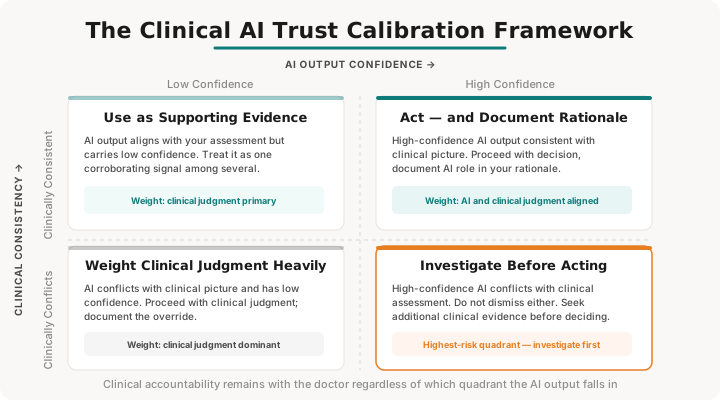
Given the realities above, how should a doctor actually use an AI clinical decision support tool in practice? The framework is not complicated, but it requires being explicit about what the doctor is doing rather than treating the AI output as either gospel or noise.
When AI confidence is high and the output is clinically consistent with the doctor’s own assessment, acting on the combined signal while documenting the clinical rationale is appropriate clinical practice. The AI is providing confirmation of a judgment the doctor had already reached through independent assessment — this is additive, not deferential.
When AI confidence is high but the output is clinically inconsistent — the sepsis risk score is high but the patient in front of the doctor does not look septic, or the drug interaction alert fires for a combination the doctor has used deliberately and appropriately — the right response is to investigate before acting, not to override reflexively but also not to defer to the number. This is the moment where the doctor’s clinical training is most important: the inconsistency is information, and it should prompt either a review of the clinical picture or a query about the model’s behaviour in this context.
When AI confidence is low, the output should be treated as advisory and weighted accordingly. A low-confidence output from a well-calibrated model is genuinely low-information; it should not drive clinical decisions but may appropriately prompt closer monitoring or a lower threshold for investigation.
An AI clinical decision support tool cannot be responsible for a clinical decision made in the doctor’s name. The tool is not the treating clinician. The doctor is.
The one invariant rule is that acting on an AI output without independent clinical assessment — using the score as a substitute for rather than an input to clinical judgment — is never appropriate, regardless of confidence level. This is not a conservative position; it is the position that follows directly from understanding what the tool is. Further guidance on building an evaluation framework for AI tools in clinical practice is available at doctors-framework-evaluating-ai-tools.html.
Regulatory and Governance Accountability
The regulatory framework governing AI clinical decision support in India is still developing, but the foundational principle is clear. The Central Drugs Standard Control Organisation classifies any software that generates clinical recommendations — risk scores intended to guide treatment decisions, diagnostic classifications, therapeutic guidance — as Software as a Medical Device (SaMD). This means the product requires regulatory oversight, and that the vendor bears responsibility for the device’s validated performance within its specified intended use. It does not mean the vendor assumes clinical accountability for decisions made using the tool.
The treating doctor retains full accountability for clinical decisions made in their name. This is not a legal technicality; it is a clinical reality. The CDSS does not see the patient, cannot examine them, cannot weigh the information from the consultation against the output on the screen, and cannot be held professionally accountable for a wrong decision. The doctor can. This accountability structure means that the doctor’s ability to critically evaluate the AI output — rather than simply receive it — is not optional. It is legally and professionally required.
At the hospital governance level, this means clear protocols are needed for how AI alerts are handled: what constitutes an appropriate override, how overrides are documented, what review mechanism exists for systematic patterns of override (which may indicate either appropriate clinical judgment or a failing AI tool), and what training is required before a doctor is expected to act on AI CDSS outputs. In the absence of such governance, individual doctors are left to develop their own implicit calibration frameworks, which is neither safe nor fair.
The data infrastructure underpinning more sophisticated CDSS — longitudinal patient records, structured clinical data, interoperable health information — is being built through the Ayushman Bharat Digital Mission. The ABDM interoperability rules are creating the technical conditions for AI tools that can draw on a patient’s full clinical history rather than only the data available within a single episode or institution. This is significant: much of the underperformance of current AI CDSS is attributable to data sparsity. As ABDM-linked longitudinal records become the norm, the quality of AI clinical decision support in India should improve materially — but only if the governance frameworks keep pace with the technical capability.
The hospital that deploys AI clinical decision support without governance protocols has not implemented AI clinical decision support. It has installed an alert system that doctors will learn to ignore.
AI clinical decision support is neither an oracle nor background noise. It is a probabilistic input from a system that may or may not be calibrated for the patient population in front of the doctor using it. The clinician who understands that distinction will use it wisely — as one input among several, weighted appropriately, overridden when clinically justified, and documented transparently. The one who does not will either ignore it entirely or follow it uncritically, and both of those are poor clinical strategies, with different failure modes but equivalent risks to patient safety.
The tools will improve. The evidence base will deepen. The regulatory frameworks will mature. But the foundational competency — using probabilistic clinical AI with calibrated, informed judgment — belongs to the doctor, not the device, and it needs to be built now.
MedAI Collective works with hospital teams across India to build structured AI governance frameworks. The Clinical AI Advisory programme supports hospitals deploying CDSS tools.