Every doctor running an Indian OPD this year has been pitched at least one AI scribe. The pitch is consistent: ambient capture of the consultation, real-time transcription, structured note in the EMR, time saved per patient measured in minutes. The reality is more uneven. Some scribes are doing exactly what is advertised. Some are producing transcripts that read fluent but contain quiet hallucinations no clinician should sign. Several are not yet usable for the bilingual, code-mixed reality of an Indian OPD.
This article is a practical breakdown of where AI scribes are in 2026, what they actually deliver in Indian clinical settings, and the specific questions a clinician should ask before adopting one.
Three Categories That Get Conflated
When people say “AI scribe,” they usually mean one of three quite different things.
The first is dictation tools with AI cleanup — the doctor speaks into a microphone after the consultation, and AI converts speech to text and lightly structures the output. These are the oldest category, most accurate, and most predictable. Dragon Medical has been doing a version of this for two decades. Modern equivalents add LLM-based formatting and some structured field extraction.
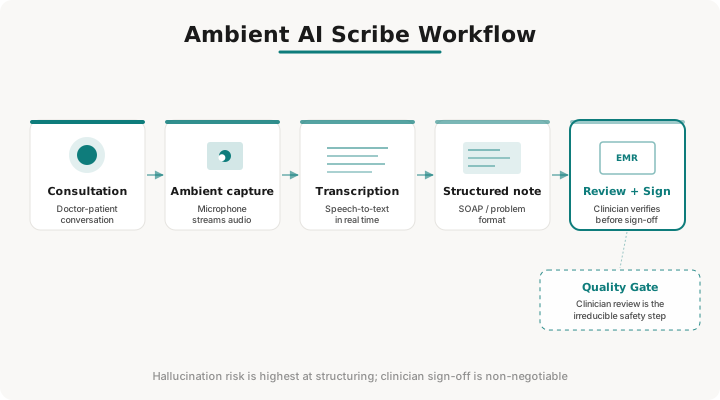
The second is ambient capture with AI summarisation — a microphone listens to the entire consultation, the conversation is transcribed, and an AI model summarises into a clinical note structure (chief complaint, history, examination, plan). This is what most new entrants in 2024–2026 mean by “AI scribe.” Quality varies enormously between vendors.
The third is conversational AI with structured field generation — beyond summarisation, the AI extracts specific data points and populates EMR fields directly: vitals, ICD codes, medication changes, referral orders. This is the most ambitious category and currently the most error-prone, particularly outside high-resource US health systems.
These three categories have different risk profiles, different price points, and different fit for an Indian OPD. Treating them as one product is the first mistake.
What Actually Works in an Indian OPD
The honest answer in 2026: dictation and structured ambient summarisation work well enough to save meaningful time when used by a clinician who reads every output before signing. Conversational structured-field generation is not yet reliable enough for unsupervised use in most Indian clinical contexts.
The most consistent feedback from clinicians who have run AI scribes for 60+ days falls into a few patterns.
Time saved per consultation is real but smaller than vendor claims. The honest number for ambient scribes in OPD use is 1.5–3 minutes per patient — meaningful at 30 patients per day, less impressive at 8. Vendor claims of 7–10 minutes per patient typically come from US specialty practices with much longer baseline note times.
Note quality is high enough to sign for routine encounters, lower for complex multi-problem visits. A diabetic follow-up with stable parameters produces a clean note. A geriatric patient with multiple new symptoms, three medication changes, and a family member providing collateral history produces a note that needs significant editing. The complexity gradient matches what the clinicians’ time savings look like — best on the simple, smallest on the complex.
Hallucination is the genuine clinical concern. Modern ambient scribes hallucinate less than first-generation tools, but they still occasionally fabricate plausible-sounding details — a medication dose the patient did not actually mention, a negative finding the doctor did not actually examine. These are hard to spot precisely because they read fluent. The clinician’s review step is not optional; it is the irreducible quality gate.
The Indian-Specific Realities
Three things make Indian OPD scribing a meaningfully different problem from US or UK scribing.
Language is code-mixed. Most Indian consultations are not in any one language. A typical exchange might mix Hindi or a regional language for patient narrative with English for clinical terminology, peppered with culturally specific idioms describing symptoms. Scribes built primarily on English training data degrade on this material. As of 2026, the better Indian-built scribes handle Hindi-English code-mixing reasonably well; Tamil, Telugu, Kannada, Malayalam, Marathi, and Bengali support varies widely; smaller regional languages are largely unsupported. If your OPD runs primarily in a non-English-non-Hindi language, ask for performance data on transcripts in that language specifically. The vendor’s confidence is not evidence.
OPD volume changes the equation. A US primary care physician sees 18–24 patients per day. A typical Indian OPD specialist may see 40–80. At that volume, even small per-patient time savings matter, but so does the cumulative review burden. If a scribe needs five seconds of review per patient, that is acceptable; if it needs forty seconds, it cannibalises the time it saved.
Data residency and ABDM compliance need explicit verification. A scribe processing patient consultations is processing personal health data under the Digital Personal Data Protection Act (DPDP). Cloud-hosted scribes with foreign data residency are legally complicated. Several Indian-built scribes offer in-country hosting; some international vendors do not. This is a procurement question that needs to be resolved before clinical pilot, not after.
Six Questions to Ask Any Scribe Vendor
If a vendor cannot answer these clearly, the procurement is not yet ready to move forward.
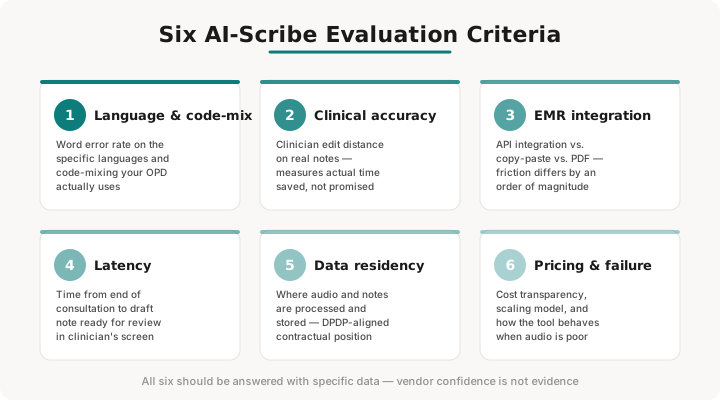
First, what is the verbatim accuracy on Indian-language and code-mixed audio? Ask for word error rate on transcripts that match the language profile of your OPD. “We support Hindi” is not an answer; “Hindi-English code-mixed audio achieves 8% WER on our held-out test set” is.
Second, what is the structured note quality, measured by clinician edit distance? A scribe whose notes get heavily edited by clinicians is not saving as much time as the raw transcription suggests. Ask for clinician edit-rate metrics from real deployments.
Third, how does it handle unfamiliar drug names, regional brand names, and dose conventions? Indian pharmacopoeia includes drug names and combinations that may not appear in scribe training data. Test specifically.
Fourth, what is the EMR integration pathway? Direct API integration, copy-paste, or PDF export are all possible. The deployment effort and the daily-use friction differ by an order of magnitude between them.
Fifth, where is patient data processed and stored, and for how long? Country of processing, encryption at rest and in transit, retention period, and the specific contractual position on training the scribe model on your patient data. The last point matters and is often glossed over.
Sixth, what is the failure-mode behaviour? When audio is poor, when the patient speaks a language the scribe does not handle well, when the conversation is interrupted — does the scribe fail loudly, fail quietly, or produce a confident wrong note? Tools that fail silently are clinically dangerous.
A Sensible Adoption Path
For a doctor or department considering an AI scribe, the path that produces the least pain is: short list two or three vendors, run each for two weeks on the same clinician, measure raw transcription accuracy and post-edit clinician time per patient, and then commit to one for a longer pilot. The vendors who survive a clinician’s two-week stress test are usually the ones worth a longer commitment.
The benefit of a working AI scribe in an Indian OPD is real — particularly for clinicians whose documentation backlog encroaches on personal time. The cost of a poorly chosen one is also real, in clinical risk and in the frustration that comes from a tool that promised time savings and delivered review burden. The choice between them is not made on the demo. It is made by asking the questions above and verifying answers with two weeks of clinical reality.
Further Reading
Authoritative references
- Ministry of Electronics and IT (MeitY) — DPDP Act resources: India’s data protection framework, applicable to any cloud-based scribe processing patient consultations.
- Ayushman Bharat Digital Mission (ABDM): national digital health stack and the data-residency standards an Indian-deployed scribe should respect.
- CDSCO India: India’s medical device regulator and current SaMD guidance.
- WHO — Digital Health: global guidance on health information systems and digital health interventions.
- HL7 FHIR: the structured-note interchange standard scribes integrating with EMRs must support.
Related perspectives from MedAI Collective
- AI in OPD Workflows: Where AI Actually Helps Clinicians
- How to Evaluate a Clinical AI Tool — A Doctor’s Framework
- Prompt Thinking for Clinicians
- Sandbox Testing for Clinical AI: A Practical Guide
- ABDM Sandbox: A Doctor’s Guide to Testing AI Integrations
- Browse all perspectives
If you are evaluating an AI scribe and want a structured framework, The Practitioner Briefing covers ambient AI tools and clinical documentation in detail — including the specific questions to take into vendor calls. For department- or hospital-level scribe rollout planning, MedAI Collective Advisory provides structured vendor-neutral guidance.