In a busy Indian OPD, a doctor may see sixty patients in four hours. That is an average of four minutes per patient — including greeting, history, examination, investigation requests, prescription, and documentation. Any AI tool introduced into this environment that adds even thirty seconds of friction per encounter costs thirty minutes of clinical time across a session. The arithmetic is unforgiving, and it should be the starting point for any conversation about AI in OPD workflow. And yet the OPD is also where AI workflow tools have the highest potential to genuinely expand clinical capacity, if they are implemented with the right sequencing and integration discipline.
The problem is that most AI tools entering Indian OPDs are not being evaluated against this standard. They are being procured by administrators who are responding to vendor demonstrations and peer institution announcements, or piloted by enthusiastic clinicians who have seen international case studies, without systematic analysis of whether the tool fits the specific volume, infrastructure, and workflow context of the OPD in question. The result is a pattern of failed deployments — tools that are technically functional but operationally abandoned within months — that creates cynicism about AI without actually testing whether well-designed AI could work. Getting OPD AI right requires understanding the Indian OPD environment first, and the AI tool second.
The Indian OPD Reality That AI Must Fit
The volume reality of Indian OPD practice is not captured by international benchmarks. Government hospital OPDs routinely operate with a hundred or more patients per doctor per session — not as exceptional events but as standard operating conditions. Even in private practice settings in metro cities, time pressure is significant, appointment slots are short by international standards, and the expectation of extended consultation time is rare. Any AI tool that has been designed and validated for a US or European primary care setting, where average consultation time may be fifteen to twenty minutes, is operating on design assumptions that are structurally mismatched with Indian OPD reality.
The documentation burden in Indian OPDs is both a genuine problem and the area of highest AI opportunity. Research across healthcare settings consistently documents that physicians spend a substantial portion of clinical time on documentation rather than direct patient care. In structured OPD settings this is reported at 30–50% of clinical time, depending on the complexity of documentation requirements and the efficiency of available systems. In the Indian context, where EMR adoption is uneven and many OPDs operate with a mix of digital prescribing and paper records, documentation is often fragmented across multiple systems — creating additional friction rather than reducing it.
The infrastructure reality is the constraint that most international AI vendor discussions fail to acknowledge. A significant proportion of Indian OPDs — particularly in tier-2 cities, smaller towns, and government settings — still operate on paper records or basic software, not on the structured EMR systems that AI workflow tools are designed to integrate with. AI documentation assistants that generate structured FHIR-formatted clinical notes require a FHIR-capable EMR to receive those notes. An AI scheduling optimisation tool requires appointment data in a format the AI can read and write to. These integrations do not exist in OPDs that are not digitised, and the most sophisticated AI tools in the world cannot overcome the absence of the data infrastructure they depend on.
The Ayushman Bharat Digital Mission is changing this — faster than many hospital administrators anticipated. The ABDM interoperability framework and the ABHA ID-linked health record system are creating regulatory and financial incentives for OPD digitisation that are producing real adoption, particularly in private hospital networks that are pursuing ABDM compliance as part of government empanelment requirements. The direction of travel is clearly toward digitised, structured, ABDM-compliant OPD records. The gap between where most Indian OPDs are today and where AI tools assume they are is closing — but it is not yet closed.
Where AI Is Entering the OPD Encounter
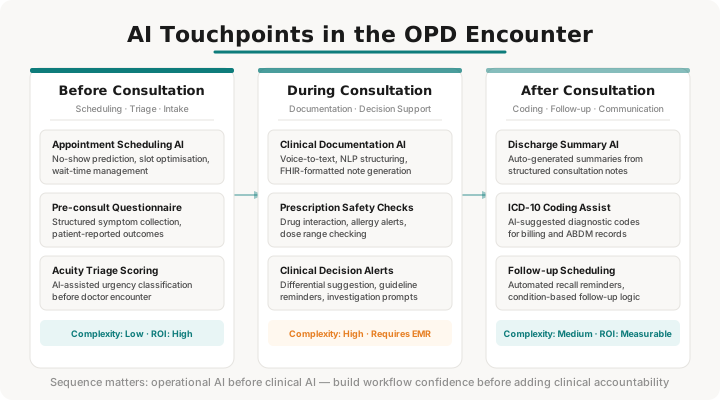
The OPD encounter has three distinct phases, and AI tools are entering at each of them with different levels of maturity, different risk profiles, and different implementation requirements.
Before the consultation begins, AI is being applied to scheduling optimisation — using historical appointment patterns, no-show rates, and seasonal demand variation to improve slot allocation and reduce wait times. Pre-consultation patient questionnaires, administered through SMS, app, or kiosk before the patient enters the consultation room, are beginning to create structured pre-encounter data that can brief the doctor before the patient arrives. Acuity-based triage scoring, which allocates patients to different urgency queues based on reported symptoms and vital signs, is an established application in emergency departments that is starting to find applications in high-volume OPD settings.
During the consultation, the most significant AI applications are clinical documentation assistance and decision support. Voice-to-text with NLP-based clinical structuring — where the consultation conversation is transcribed and automatically formatted into a structured clinical note — is the application with the highest potential for time recovery in OPD settings. Clinical decision support alerts (drug interaction checking, dose guidance, investigation recommendations) are entering OPD practice primarily through prescribing platforms. The detail of how clinical decision support operates, and how doctors should calibrate their trust in AI alerts, is covered at ai-clinical-decision-support.html.
After the consultation, AI is being applied to discharge summary generation, ICD-10 diagnostic coding for billing and reporting purposes, follow-up appointment scheduling based on clinical protocols, and automated patient communication (appointment reminders, post-consultation instructions, investigation collection alerts). These post-encounter applications are generally lower clinical risk than in-consultation tools and have clearer operational ROI — particularly ICD coding, where AI-assisted coding can meaningfully reduce both the time spent on administrative coding and the error rates that affect claims.
AI-Assisted Documentation: The Highest-Value OPD Application
Documentation is the single largest AI opportunity in OPD workflow — not because it is the most glamorous application but because it is where clinical time is most consistently lost to non-clinical tasks. The doctor who spends forty-five minutes of a four-hour session typing prescriptions and clinical notes is spending nearly twenty percent of their clinical time on a task that, in principle, an AI tool could handle more quickly without reducing the quality of the clinical record.
Internationally, ambient voice AI tools like Nuance DAX (Microsoft) represent the current leading approach to AI-assisted clinical documentation. These tools listen to the consultation conversation, transcribe it in real time, and generate a structured clinical note — formatted to the institution’s documentation requirements — without the doctor needing to type, dictate, or perform any separate documentation step. The doctor reviews and approves the generated note before it is finalised, maintaining clinical accountability while significantly reducing the documentation time investment. The commercial deployment of tools like this in US and UK healthcare settings has produced documented time savings that are material at the scale of an OPD session.
In the Indian context, the challenge is structural and linguistic. India’s OPDs operate in a multilingual environment where a single consultation may involve the doctor and patient switching between a regional language, English, and a mixture of both — often with medical terminology that exists in a transliterated form that is neither formal English nor formal regional language. A doctor in Tamil Nadu may greet a patient in Tamil, take a history in a Tamil-English mix, document vitals in numbers with English units, and write a prescription in English with abbreviated Latin notation. Clinical voice AI that performs well in English or in a single language will fail in this environment. Indian-language clinical voice AI — robust enough to handle multilingual code-switching, regional accent variation, and clinical terminology — is an active development area, but mature, widely deployed solutions are not yet available. This is a genuine constraint on the deployment timeline for ambient documentation AI in most Indian OPD settings.
The pathway forward is connected to ABDM. The FHIR-based documentation standards that ABDM mandates create both a technical pathway and a regulatory incentive for structured AI-assisted clinical documentation. An OPD operating on an ABDM-compliant EMR already has the structured data format that AI documentation tools need to write to. The AI tool becomes, in this model, the interface through which structured FHIR records are created — reducing documentation burden while simultaneously producing the interoperable, structured data that enables downstream AI applications. The practical reality remains: documentation AI works best when the EMR is already stable, structured, and consistently used. Deploying voice AI on top of an inconsistent or partially paper-based system will not produce structured clinical records. It will produce unstructured transcripts that create a new data quality problem rather than solving the documentation burden.
Pre-Consultation Triage and Symptom Intelligence
AI-assisted pre-consultation tools — symptom checkers, patient-reported outcome questionnaires, structured intake forms with acuity scoring — operate on the premise that a doctor who arrives at the consultation with structured information about the patient’s presenting concern can use the consultation time more efficiently than one who is starting from scratch. The concept is sound. The implementation challenges in the Indian context are significant.
In urban, digitally-enabled practices, structured patient intake is beginning to work. Platforms like Practo and several hospital-specific patient apps have implemented pre-consultation data collection that creates a structured presenting complaint before the doctor opens the case. The quality of this data — and therefore its clinical utility — depends heavily on patient engagement with the tool: on their willingness to complete the intake, their literacy in the language the tool presents, and their familiarity with the digital interface. In patient populations with high digital health engagement, this works. In populations that are older, less digitally fluent, or accessing healthcare in regional languages not supported by the tool, it does not.
The scale limitation of current pre-consultation AI tools in India is therefore a population coverage limitation. The tools that exist are designed for a patient profile — urban, smartphone-literate, comfortable with English or Hindi digital interfaces — that represents a fraction of the Indian OPD patient population. The WHO’s guidance on AI in primary care emphasises equity of access as a design requirement for AI health tools, not an afterthought. Tools that work for the most digitally advantaged patients while creating new barriers for others do not represent an improvement in healthcare delivery; they represent a stratification of it.
The tools that have genuine potential to scale in the Indian OPD context are low-friction, multilingual, require minimal patient technical sophistication, and function adequately on basic smartphones or SMS interfaces. This is a significantly higher design bar than most current symptom checker or patient intake products meet. It is also the direction in which the most thoughtful Indian health technology development is moving — not because international tools are being imported unchanged, but because the design constraints of Indian healthcare are producing genuinely different product development requirements.
The Workflow Integration Problem Specific to OPD
OPD workflow has a fundamentally different character from inpatient care, and this difference is consistently underestimated by AI vendors whose products are designed for, or primarily validated in, inpatient settings. Inpatient clinical workflows are slower-paced, more standardised, more amenable to structured documentation practices, and involve longer time horizons over which an AI tool can demonstrate its value. OPD workflows are faster, higher-interruption, less standardised, and involve much shorter windows of clinical attention in which an AI tool must deliver its value or be abandoned.
The “add-on portal” failure mode is the most common implementation error in OPD AI deployment. This is the pattern in which an AI tool is introduced as a separate system — a risk dashboard that exists in a different tab, a clinical decision support alert that fires in a separate window, a documentation assistant that requires the doctor to open a dedicated application — that requires the clinician to actively context-switch to access. In an inpatient setting, where a doctor may spend several minutes on a single case, a context switch has manageable cost. In an OPD seeing sixty patients, where the doctor has four minutes per encounter, a context switch has no place in the workflow. Tools that require one are effectively excluded from OPD practice regardless of their technical quality.
What integration actually means in OPD practice is that the AI tool’s output appears within the doctor’s primary working interface — the prescribing screen, the encounter note in the EMR, the lab order entry interface — without requiring any additional navigation. A drug interaction alert that appears as a contextual flag within the prescription entry form is an integrated tool. A drug interaction alert that requires clicking through to a separate clinical decision support portal is an add-on that will be ignored. This distinction is not a user experience preference; it is the operationally decisive factor in whether an OPD AI tool is actually used.
The time economics of OPD AI are also different from inpatient AI in ways that should drive procurement decisions. In an inpatient setting, a two-minute AI-assisted documentation step that produces a higher-quality discharge summary is a reasonable trade. In an OPD seeing sixty patients, a two-minute documentation step per encounter is two hours of additional clinical time across the session — which defeats the purpose entirely. The return-on-time calculation for OPD AI tools must be measured in seconds, and any tool that cannot demonstrate a positive return in seconds-per-encounter has not been designed for OPD deployment. Further analysis of AI integration failures in clinical workflow is available in the overview at ai-for-doctors.html.
An AI tool that saves thirty seconds per encounter across sixty patients creates thirty minutes of clinical capacity per session. An AI tool that costs thirty seconds per encounter destroys thirty minutes. The arithmetic of OPD AI is unforgiving in both directions.
What a Well-Designed AI-Augmented OPD Looks Like
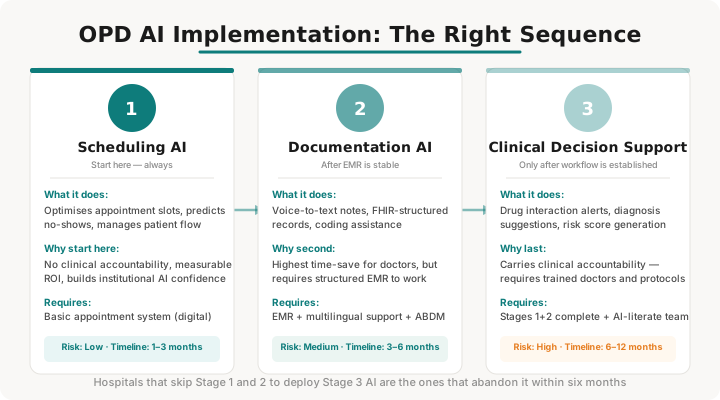
A phased implementation model — moving from lower-risk, operational AI applications to higher-complexity clinical AI as the workflow and governance foundations mature — is the approach most likely to produce durable results in Indian OPD settings.
Scheduling AI is the logical starting point. Appointment optimisation, no-show prediction, and slot management are operational applications with no clinical accountability dimension, measurable and straightforward ROI, and minimal workflow integration complexity. They operate on administrative data that is already structured in most appointment management systems, and their outputs affect scheduling staff and administrators rather than placing new demands on clinicians. A hospital that deploys scheduling AI well can demonstrate measurable improvements in OPD throughput and patient wait time before any clinical AI is introduced — building institutional confidence and data infrastructure simultaneously.
Documentation AI is the second stage, and requires substantially more foundation work. Effective voice-to-text documentation requires a stable, consistently-used EMR that can receive structured outputs; a multilingual capability adequate to the specific linguistic environment of the OPD; privacy and data governance frameworks that address the consent and data handling implications of ambient audio recording during clinical consultations; and a review workflow that maintains the doctor’s accountability for the note content. None of these requirements is insurmountable, but each requires deliberate planning. Hospitals that attempt to deploy documentation AI before the EMR foundation is stable will generate unstructured transcripts and workflow disruption rather than time savings.
Clinical decision support is the highest-complexity stage and should follow, not precede, stable workflow and documentation. The sequencing logic is straightforward: a doctor who is managing a new documentation tool while also learning to interpret a new AI alert system is carrying unnecessary cognitive load, and the result is typically that both tools are used poorly. Starting with low-stakes decision support (drug interaction checking, dose guidance) after the workflow is stable allows clinicians to build calibrated trust in AI outputs without the additional complexity of simultaneous workflow change.
ABDM and the AI-Ready OPD
The Ayushman Bharat Digital Mission is building the longitudinal data infrastructure that makes sophisticated OPD AI technically feasible. The ABHA ID — the unique health identifier that links a patient’s clinical records across providers — creates the mechanism through which a doctor in an ABDM-compliant OPD can access a patient’s prior consultation history, laboratory results, imaging reports, and prescribed medications from any linked provider. This is not a small capability. It transforms the clinical context available at the point of care from a single-episode snapshot to a longitudinal clinical narrative.
The implications for AI are significant. Most current OPD AI tools are episode-based: they work with the data available in the current encounter, which is limited to what the doctor has recorded and what the patient can recall. An AI tool operating on longitudinal ABDM-linked records can provide context-aware clinical intelligence — flagging, for example, that a patient presenting with chest pain has a documented history of anxiety disorder and prior negative cardiac workups, or that a prescription being considered includes a drug the patient was documented as not tolerating in a consultation at a different facility two years ago. This kind of context-awareness is qualitatively different from episode-based AI, and it requires the longitudinal data that ABDM is creating.
The hospitals that implement ABDM compliance now — building ABHA-linked OPD records, structured FHIR documentation, and the data governance frameworks that manage longitudinal health data — are building the infrastructure on which meaningful OPD AI will run in the 2027-2029 period. The AI tools that will be available then are more capable than those available now, and they will work best on the richer, more structured, more longitudinal data that ABDM compliance produces. The hospitals that defer digitisation and ABDM adoption will be starting from scratch when those tools mature — not as a minor inconvenience but as a genuine infrastructure gap that takes years to close.
The OPD that becomes ABDM-compliant in 2026 is not just meeting a regulatory requirement. It is building the data foundation that will make AI-assisted clinical practice meaningfully better in 2028.
The OPD is not waiting for AI — AI is arriving in Indian OPDs now, through scheduling tools, documentation platforms, and pharmacy integrations, largely without structured evaluation or clinical governance. The consequences of poor implementation are not theoretical: they are the abandoned tools, the alert systems that generate noise instead of signal, the documentation platforms that add time instead of saving it, and the clinical staff who become cynical about AI based on encountering it in its poorly-implemented form.
The doctors and administrators who understand what good OPD AI implementation looks like — the sequencing, the integration requirements, the volume economics, the infrastructure prerequisites — are the ones who will shape whether AI creates genuine clinical capacity in their OPDs or simply creates new categories of operational problem. That understanding starts with the workflow, not the algorithm. The algorithm can be evaluated once the workflow context is clear. In Indian OPDs, that context is specific, demanding, and consequential, and it should be the first thing any AI vendor is asked to demonstrate they understand.
MedAI Collective advises hospital teams on AI adoption strategy and workflow integration. For OPD-specific AI implementation guidance, see our Advisory Consulting programme.