The hospital AI readiness frameworks that circulate in industry whitepapers were almost all written for tier-1 corporate chains: Apollo, Manipal, Fortis, Max. They assume central IT teams of 30+, dedicated data infrastructure, board-level CIO mandate, and budgets in tens of crores. They are not wrong for those organisations. They are nearly useless for the 100–300 bed hospitals where most Indian healthcare actually happens.
A 200-bed multi-specialty hospital in Pune, Coimbatore, or Lucknow is a different operational reality. The CMO is often clinically active. IT is a team of three to seven, not thirty. The HIS is functional but rarely fully utilised. Clinical data exists but is fragmented across modalities. Decisions about AI adoption are made by two or three people in a room, not committees. The framework that fits this reality is not a scaled-down version of the corporate one — it is a different framework with different priorities.
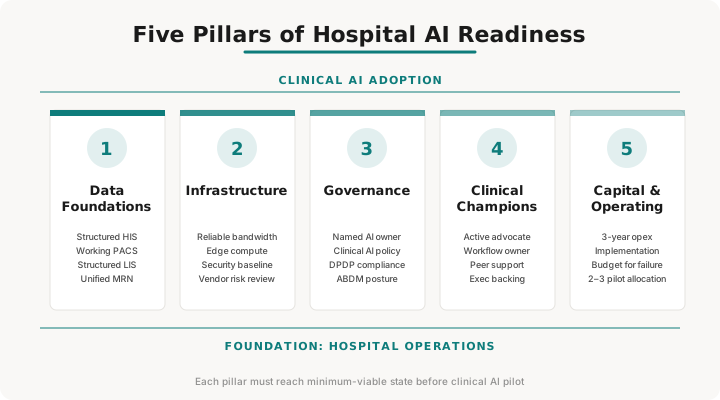
This article is that framework. It is built around five readiness pillars, with concrete questions for each, and a maturity model that maps where most mid-size Indian hospitals actually start.
Pillar 1: Data Foundations
AI is built on data. A hospital that cannot reliably retrieve its own clinical data cannot run an AI pilot, regardless of what the vendor’s pitch promises.
The questions that matter at this pillar:
Is your HIS capturing structured clinical data, or is it primarily a billing system with free-text notes attached? Most mid-size Indian hospitals have an HIS that does the first 70% of patient management well — registration, billing, pharmacy, discharge — and the clinical documentation 30% poorly. AI tools that need structured medication lists, problem lists, or vital trends will fail on a billing-first HIS even if the HIS vendor’s brochure says otherwise.
Is imaging data digital and retrievable? A hospital with a working PACS is in a fundamentally different position from one where radiology reports are typed but images are still stored on workstation hard drives or burned to CDs. AI-radiology tools assume PACS-level retrievability. If you do not have it, that is the prerequisite project, not the AI project.
Is laboratory data structured and queryable? LIS systems vary enormously. A modern LIS with HL7 output is workable; a system that produces lab reports as PDFs only is not.
Can you identify the same patient across modalities? A unified MRN is so basic it is easy to overlook, but many hospitals have separate IDs for OPD, IPD, lab, and imaging. AI projects that require cross-modal data fail at this step before any model is involved.
The honest minimum viable state for this pillar: structured HIS clinical capture for at least one specialty, working PACS, structured LIS, and a unified MRN. If you do not have these, fix them first. AI on a broken data foundation produces no clinical value and a great deal of expensive disappointment.
Pillar 2: Infrastructure
The infrastructure question is narrower than people assume. You do not need a private cloud, a GPU cluster, or a data lake to run a clinical AI pilot. You need three specific things.
Reliable internet of sufficient bandwidth. Cloud-based clinical AI tools require stable upload bandwidth, particularly for imaging. A hospital with intermittent fibre and ADSL backup will struggle. The cost of upgrading is usually modest; the cost of running clinical AI on flaky internet is operationally high.
Sufficient compute at the edge for tools that need it. Some AI tools are entirely cloud-based; others require on-premise inference for latency or data residency reasons. Clarify this for any tool you consider, and know what your edge compute capacity is.
A workable IT security posture. Most mid-size Indian hospitals run with informal IT security. Bringing AI tools — particularly cloud-connected ones — exposes the hospital to risks the existing security posture may not be ready for. A basic information security review before procurement is non-negotiable, even if your IT team views it as overhead.
The minimum viable state: 50+ Mbps upload, basic edge compute capacity, and an information security baseline that includes vendor risk review.
Pillar 3: Governance and Compliance
This pillar is where mid-size hospitals most often skip steps that come back to bite them.
Is there a named AI accountability owner? Not a committee — a person. The AI tools your hospital adopts will produce decisions that affect patients. When they go wrong, someone is accountable. That person must be named in advance, not retroactively. In most mid-size hospitals, the right person is the Chief Medical Officer or Medical Director.
Is there a clinical AI policy? A short document — three to five pages — that states what AI tools the hospital will and will not adopt, what review is required before adoption, what consent is required from patients, what to do when an AI tool fails or produces unexpected output, and how clinicians are trained before use. This document does not need to be sophisticated. It needs to exist.
Is your DPDP compliance posture clear? The DPDP Act applies to any processing of patient data, including data shared with AI vendors. Cloud-based AI tools route patient data outside hospital systems. The contract with the vendor must address data processing, retention, training-on-customer-data clauses, and breach notification. If your hospital’s standard vendor contract does not handle these, the AI procurement is the moment to fix that template.
Is ABDM integration in scope? Increasingly, AI tools want to read from or write to ABDM-compliant data systems. Whether your hospital is ABDM-integrated affects which AI tools you can adopt and how.
The minimum viable state: a named AI owner, a one-page clinical AI policy, DPDP-compliant vendor contracts, and clarity on ABDM posture.
Pillar 4: Clinical Champions
This is the pillar that separates AI projects that succeed from those that fail. Hospitals that adopt AI without clinical champions produce expensive shelfware.
Is there at least one clinician who actively wants this tool? Not who agreed in a meeting, but who is willing to advocate for it, use it daily, debug its problems, and explain it to colleagues. Without this person, the tool will not be used regardless of how good the technology is.
Has the clinical champion negotiated their workflow change? AI tools change clinical workflow. Even good changes generate friction in the first weeks. The champion needs to have thought through what their day looks like with the tool, what changes for nurses and junior doctors, and what stays the same.
Is there clinician peer support? A single isolated champion produces a single user. A small group of clinicians who all see the value produces clinical adoption.
The minimum viable state: at least one named clinical champion with executive-leadership support and a peer group of two to three colleagues willing to participate in pilot.
Pillar 5: Capital and Operating Budget
The financial pillar gets disproportionate attention upfront and disproportionately little attention after procurement. Both are mistakes.
Is the licensing cost in the operating budget, not just capital? Most clinical AI is sold as a subscription. The hospital that capitalises the first-year licence and forgets to budget for years two and three discovers a problem at renewal. AI tools are operating expenses for their entire lifetime.
Is implementation cost realistically scoped? Vendor quotes typically cover software. Implementation includes hardware upgrades, integration work, clinician training time, change management, and ongoing IT support. The realistic total is usually 1.3 to 2 times the licence quote in year one.
Is there budget for failure? Some pilots will fail. The hospital that has not budgeted for one or two failed pilots does not actually have an AI strategy; it has a single bet. A reasonable mid-size hospital AI budget allocates for two or three pilots over 18 months, expecting one to scale.
The minimum viable state: three-year operating budget, realistic implementation scoping, and explicit allocation for at least two pilots.
Where Most Mid-Size Hospitals Actually Start
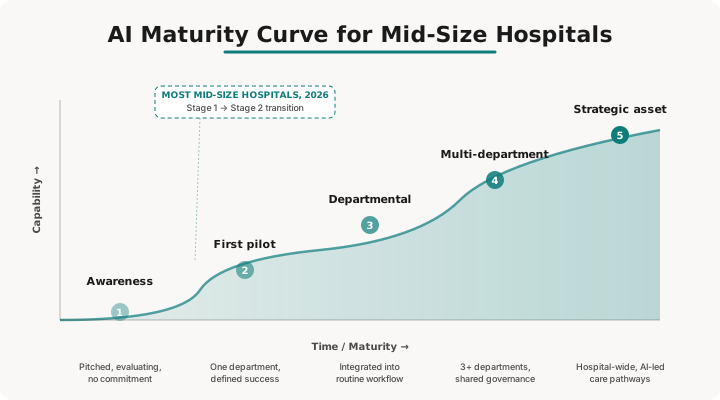
The honest assessment: most 100–300 bed Indian hospitals are at Stage 1 — Awareness — in 2026. Leadership is aware that AI is happening, has been pitched several tools, and is unsure how to evaluate them. Some have already bought a tool that has not been used; some are paralysed by the procurement decision; some are running quiet pilots with whatever tool a junior doctor brought in.
The path from Stage 1 to Stage 2 — First Pilot — is not paved by buying a more impressive tool. It is paved by working through the five pillars above and identifying the readiness gaps that would sink any pilot regardless of vendor. A hospital that fixes its data foundation and names a clinical champion will run a successful pilot of a modest AI tool. A hospital that buys an impressive AI tool without those foundations will not.
The checklist matters more than the technology. It is also the part of AI strategy that is least exciting to discuss in board meetings. Both are reasons to take it seriously.
Further Reading
Authoritative references
- Ayushman Bharat Digital Mission (ABDM): the national digital health stack — readiness for ABDM integration is increasingly a procurement-critical requirement.
- Ministry of Electronics and IT (MeitY) — DPDP framework: India’s Digital Personal Data Protection Act, governing patient data processing in clinical AI.
- NABH — National Accreditation Board for Hospitals: Indian hospital accreditation standards, increasingly aligned with digital health and data governance expectations.
- CDSCO India: software-as-medical-device classification and regulatory pathway.
- WHO — Digital Health: global guidance on health information systems and digital interventions.
- HL7 FHIR: the interchange standard for clinical data infrastructure your hospital will need to support.
Related perspectives from MedAI Collective
- AI Clinical Decision Support: What Works in Indian Hospitals
- Types of Clinical Data — A Practical Taxonomy for AI Projects
- AI Foundations for Clinicians
- ABDM 3.0: New Interoperability Rules Explained
- ABDM Sandbox: Testing AI Integrations
- Selling Clinical AI to Indian Hospitals — A Founder’s GTM Playbook
- Browse all perspectives
If your hospital is sitting between Stage 1 and Stage 2 and would benefit from an external readiness assessment, MedAI Collective Advisory runs structured AI readiness reviews for mid-size hospitals — covering all five pillars and producing a written gap analysis with prioritised recommendations. Department heads and clinical leads can also join an upcoming Practitioner Briefing to align teams before procurement.