A small clinical AI startup in Bengaluru, three months from launch, discovers that their tool will need to read consent-gated patient data from ABDM-compliant Health Information Providers. A district hospital in Maharashtra wants to integrate an AI screening tool with their HIS but does not know whether the tool’s data flows are ABDM-compatible. A senior consultant in Delhi wants to verify before pilot that an AI scribe his department is considering will actually work end-to-end with the digital health stack the hospital is migrating to.
All three of these situations have the same answer: the ABDM sandbox. It is the testing environment maintained by the National Health Authority where developers, hospitals, and clinicians can verify that AI tools and other applications integrate correctly with the Ayushman Bharat Digital Mission infrastructure — without touching any real patient data.
The sandbox is genuinely useful, and it is also genuinely under-used. Most clinicians have never heard of it. Most procurement decisions about AI tools that should pass through ABDM compliance happen without anyone testing the integration before the deal closes. This article is a practical guide to what the ABDM sandbox is, what it tests, and how a clinician or small team can actually use it.
What the ABDM Sandbox Actually Is
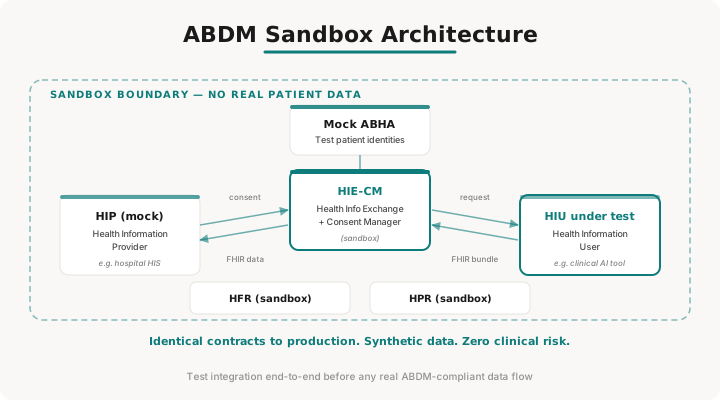
The Ayushman Bharat Digital Mission is a federated digital health infrastructure. It does not store patient data centrally; it provides identity (ABHA), discovery (Health Facility Registry, Healthcare Professional Registry), consent management (the Health Information Exchange and Consent Manager, HIE-CM), and standardised interfaces between Health Information Providers (HIPs, who hold patient data — usually hospitals and clinics) and Health Information Users (HIUs, who request patient data — including AI tools, telemedicine platforms, and longitudinal record viewers).
The ABDM sandbox is a parallel version of this entire infrastructure. It has a sandbox ABHA service, sandbox HIE-CM, sandbox registries, and sandbox HIP and HIU endpoints. None of it is connected to real production systems. None of the data is real. But the API contracts, the FHIR profiles, the consent flows, and the integration patterns are identical to production.
This means a developer or hospital integration team can build, test, and refine an integration entirely in the sandbox before any real patient data is involved. It is the right place to discover that your FHIR bundle does not validate, that your consent artefact handling has a bug, or that your authentication flow times out under realistic load.
For clinical AI tools specifically, the sandbox lets you test:
- That the tool can request data through ABDM consent flows
- That the tool can write outputs back to a patient’s longitudinal record if it needs to
- That the tool’s data handling matches DPDP and ABDM specifications
- That the integration works at the technical level before clinical pilot
Who the Sandbox Is Actually For
There is a misconception that the ABDM sandbox is only for software developers building HIPs or HIUs. This is partially true and operationally misleading.
The sandbox is genuinely useful for three audiences:
Healthtech developers — the obvious users. Anyone building a health application that needs ABDM integration must use the sandbox during development.
Hospital IT teams — particularly during HIS migration or vendor-evaluation projects. Testing whether a candidate HIS or a proposed AI tool actually integrates with ABDM before procurement is significantly cheaper than discovering integration problems after deployment.
Clinicians evaluating tools — perhaps the most underused audience. A senior clinician evaluating an AI vendor’s claim of ABDM compliance can ask the vendor to demonstrate the integration in the sandbox. Most vendors who genuinely have ABDM-compliant tools can do this in 30 minutes; vendors who claim compliance but cannot demonstrate it usually have not actually built it.
The clinician does not need to be technical. The point is to require the demonstration. “Show me the consent artefact request and response in the ABDM sandbox” is a question with a binary answer that cuts through marketing claims efficiently.
The Five-Step Testing Journey
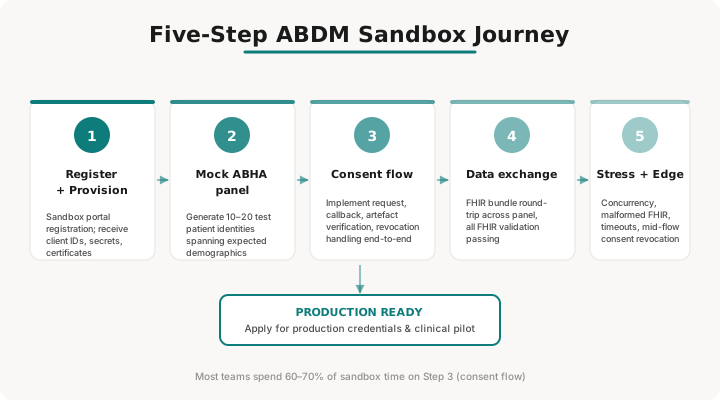
For a healthtech team or hospital IT team that needs to actually use the sandbox, the journey has five stages. Each stage has a specific purpose and a specific exit criterion.
Step one: register and provision sandbox credentials. Registration happens through the ABDM sandbox portal. The process requires basic organisational details and produces a set of sandbox credentials — client IDs, secrets, and certificates that allow your application to authenticate against the sandbox infrastructure. Expect this to take a few days from request to credentials in hand. The exit criterion is simple: you can authenticate against the sandbox.
Step two: create mock ABHA addresses for testing. The sandbox exposes a mock ABHA creation endpoint. You generate test patient identities — fictional names, mobile numbers, demographic profiles — that will serve as your test patients throughout the integration work. A reasonable test set includes ten to twenty diverse mock patients covering the demographic and clinical variety you expect in real use. The exit criterion: a documented test patient panel.
Step three: implement and test the consent flow. This is where most integration projects spend most of their sandbox time. The ABDM consent flow involves multiple API calls, callback patterns, and timing constraints. Implementing it correctly requires getting the request format right, handling the consent artefact correctly, and managing edge cases like consent revocation and expiry. The exit criterion: your application can request, receive, and verify a consent artefact end-to-end.
Step four: implement and test the data exchange. Once consent is in place, the actual data exchange happens through FHIR-formatted bundles passed via the HIE-CM. For an AI tool, this typically means receiving a structured patient record, processing it, and optionally writing back results. The exit criterion: a clean round-trip data exchange against your mock patient panel, with all FHIR validation passing.
Step five: stress and edge-case testing. Before treating the integration as production-ready, exercise it under stress and against edge cases. Concurrent consent requests. Partial or malformed FHIR bundles. Network timeouts and retries. Consent revocation mid-data-fetch. Each of these reveals robustness issues that a happy-path test misses. The exit criterion: documented behaviour for each edge case, with the answers being acceptable rather than dangerous.
What the Sandbox Does Not Do
It is worth being explicit about the sandbox’s limits. The ABDM sandbox tests technical integration. It does not test clinical safety. It does not test the AI model itself. It does not test workflow fit. A tool that passes ABDM sandbox testing may still be clinically inappropriate, poorly validated, or operationally unworkable. The sandbox is a necessary check, not a sufficient one.
Specifically, the sandbox does not provide:
Clinical validation. Whether an AI tool produces clinically correct output is a separate testing exercise — sandbox or otherwise — that the ABDM sandbox does not address.
Real-world data testing. Mock patient data has structural realism but lacks the messiness of real clinical data. Tools that pass sandbox testing on synthetic data may struggle on real data.
Performance testing at production scale. The sandbox is not a load-testing environment. Production-scale performance must be verified separately.
Clinical workflow validation. Whether the integrated tool actually fits clinician workflow is a clinical pilot question, not a sandbox question.
A complete pre-production testing approach uses the ABDM sandbox in combination with vendor sandboxes, clinical validation studies, and a controlled clinical pilot. Each addresses a different risk class.
How a Clinician Should Use This Knowledge
If you are a practising clinician — not a developer, not an IT lead — the ABDM sandbox is still relevant to you in a specific way. When your hospital is procuring or piloting an AI tool, the questions you should ask the vendor include:
- “Have you tested this integration against the ABDM sandbox?”
- “Can you demonstrate the consent flow in the sandbox?”
- “What is the FHIR profile your tool produces, and has it been validated?”
A vendor who can answer these confidently and demonstrate them is operating at a meaningfully higher quality bar than one who cannot. This is not the only quality dimension that matters — clinical validation matters more — but it is one of the cleaner technical signals available to non-technical evaluators. Tools that fail this signal often fail others.
Asking the question costs nothing. It surfaces information that procurement processes routinely miss. And it sends a signal to the vendor — one repeated across enough hospitals — that ABDM compliance and clinical AI integration are not optional add-ons.
The ABDM sandbox is one of the more useful pieces of public infrastructure that India has built for healthcare. Most of its value is realised when developers, hospital IT teams, and clinicians use it deliberately. The path from “I have heard of ABDM” to “I have tested an integration in the sandbox” is shorter than most clinicians assume.
Further Reading
Authoritative references
- Ayushman Bharat Digital Mission (ABDM) — Official: the home of India’s national digital health mission, with policy, architecture, and program documentation.
- ABDM Sandbox: the developer portal where sandbox credentials, mock APIs, and integration tests live.
- National Health Authority (NHA): the implementing agency behind ABDM, with guidance on Health Facility Registry, Healthcare Professional Registry, and ABHA.
- CDSCO India: India’s medical device regulator — relevant for clinical AI tools that integrate with ABDM and require SaMD classification.
- Ministry of Electronics and IT — DPDP Act framework: India’s data protection law governing how AI tools handle ABDM-routed patient data.
- HL7 FHIR: the interchange standard ABDM uses for structured clinical data exchange.
- WHO — Digital Health: global digital health frameworks that contextualise ABDM’s design.
Related perspectives from MedAI Collective
- ABDM 3.0: New Interoperability Rules Explained
- Types of Clinical Data — A Practical Taxonomy for AI Projects
- AI Foundations for Clinicians
- Sandbox Testing for Clinical AI: A Practical Guide
- AI Readiness Checklist for 100–300 Bed Hospitals in India
- Selling Clinical AI to Indian Hospitals — A Founder’s GTM Playbook
- Browse all perspectives
For hospitals or healthtech teams that need structured help with ABDM integration testing or sandbox-based vendor evaluation, MedAI Collective Advisory runs targeted sessions on ABDM compliance and integration strategy. Founders building ABDM-integrated AI tools can also engage MedAI Collective Consulting for end-to-end integration roadmap support.