A patient walks into an Indian dermatology clinic with a screenshot from a smartphone app. The app — free, three taps from camera roll to verdict — has confidently classified the patient’s mole as “likely melanoma; see a doctor immediately.” The dermatologist examines the lesion clinically. It is a benign seborrhoeic keratosis, a common and harmless growth.
Variations of this scene now occur multiple times per week in dermatology clinics across India. The apps doing this classification range from genuinely useful clinical decision support tools to consumer products whose technical underpinnings would not survive five minutes of clinician scrutiny. Telling them apart matters — both for the dermatologists fielding the questions and for patients who increasingly use these apps before a clinical visit.
This article is a practitioner’s guide to dermatology AI apps as they exist in 2026 — what they actually do, where the evidence is strong, where the failures are systematic, and how a clinician should think about recommending or rejecting any specific tool.
Three Categories of Tool That Get Conflated
When “dermatology AI app” is used loosely, it usually refers to one of three quite different categories of product.
The first is clinician-facing decision-support tools designed for use by qualified dermatologists. These integrate with dermoscopy or teledermatology workflows, are typically validated against expert dermatologist consensus, and are marketed via clinical channels. Vendors include established names with peer-reviewed validation and CE Mark or FDA SaMD clearance.
The second is consumer apps with clinical positioning — smartphone apps marketed to the general public but claiming clinical utility. Quality varies enormously. Some are well-validated for narrow tasks; many have weak or absent evidence.
The third is general-purpose image-classification tools repurposed for skin assessment. These are not validated for clinical use at all and should not be in clinical conversation.
Conflating these three is the first source of confusion. A dermatologist evaluating “AI for skin lesions” needs to know which category the specific tool falls into before any other question matters.
Skin-Tone Bias: The Central Issue in 2026
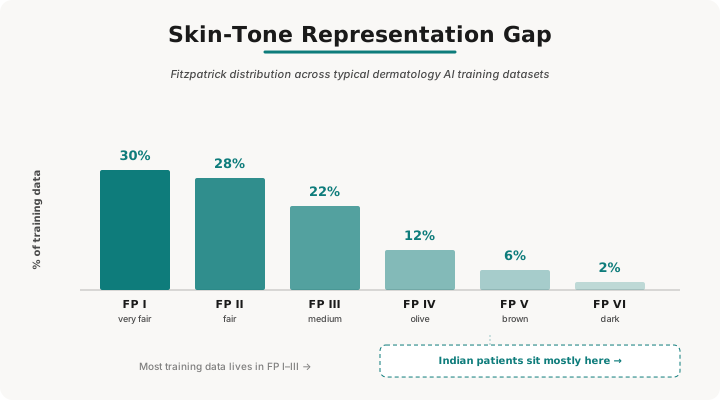
The single most-cited failure mode of dermatology AI is performance on darker skin tones. The reason is well-documented and concrete: most published dermatology AI training datasets contain predominantly Fitzpatrick I–III skin (lighter tones), with Fitzpatrick V–VI underrepresented by a wide margin. A model trained on a dataset that is 90% lighter skin learns what skin cancer “looks like” in that distribution. Applied to darker skin, performance degrades — often substantially.
This is a real clinical issue, not a theoretical concern. Studies have shown sensitivity drops of 15–30% for malignant lesion detection on darker skin tones in models trained without explicit attention to this gap. For Indian dermatologists, where the patient population spans Fitzpatrick III–V dominantly, this affects what proportion of the published literature actually applies to their practice.
The honest position in 2026 is that most globally-available dermatology AI tools are weakest on the patient populations they are most often needed for in India. Tools that explicitly publish per-skin-tone performance metrics are the minority; tools that have actively addressed the bias in training are a smaller minority still.
What Actually Works
Despite the caveats, dermatology AI has real clinical utility in several specific scenarios.
Dermoscopy-assisted lesion assessment for trained users. AI-assisted dermoscopy, used by dermatologists familiar with dermoscopy interpretation, has demonstrated meaningful benefit in published trials. The benefit is incremental — the AI does not replace the dermatologist’s judgment but flags additional features the human review may underweight. Use case: triage of pigmented lesions, second opinion on borderline dermoscopic cases.
Teledermatology triage at scale. AI-pre-screening of dermatology images submitted via teledermatology platforms can prioritise queues and route urgent-appearing lesions to faster review. The AI does not make the diagnosis; it sorts the inbox. Used appropriately, this is a meaningful efficiency gain in high-volume teledermatology services.
Patient education and self-monitoring. Consumer apps that help patients track moles over time — taking calibrated photographs at intervals, highlighting visible changes — provide real value as documentation tools, separate from any diagnostic claim.
Clinical photography standardisation. AI tools that help clinicians take consistent dermatology photographs — lighting, framing, distance — are workflow tools that improve the quality of records and subsequent clinical or AI review.
What does not yet work reliably enough for clinical use, regardless of vendor claims: definitive diagnosis from a single smartphone photograph, melanoma detection from non-dermatologist user input on diverse skin tones, and screening recommendations replacing dermatologist consultation.
Red Flags in Vendor Claims
Several common patterns in dermatology AI marketing should raise immediate skepticism.
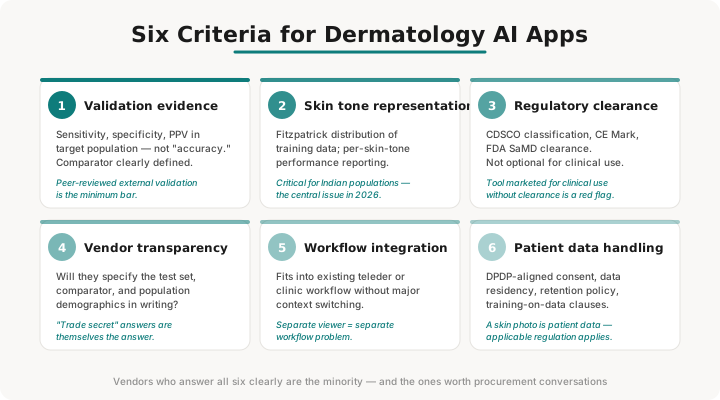
“99% accuracy in detecting skin cancer.” Accuracy is an almost meaningless metric in a low-prevalence problem like skin cancer detection. Sensitivity and specificity at clinically useful thresholds matter; reported accuracy on balanced test sets does not generalise to real clinical populations. Vendors who lead with accuracy claims rather than sensitivity, specificity, and PPV in the target population are usually marketing rather than communicating clinical performance.
“Trained on millions of images.” Training set size matters less than training set composition. A million images that are 90% lighter skin will produce a model that fails on darker skin regardless of total volume. Ask about the demographic and lesion-type distribution, not the size.
No regulatory clearance, but “for clinical use.” A tool marketed for clinical decision support without CDSCO classification (in India), CE Mark, or FDA clearance is making a regulatory claim it has not earned. This does not mean the tool is bad, but it does mean it has not been independently reviewed for safety and performance.
Closed validation methodology. Vendors who will not specify the test set, the comparator (dermatologist consensus? biopsy ground truth?), and the population characteristics of validation studies have not done the work expected of clinical AI.
No mechanism for incorrect outputs. Tools that produce confident diagnoses with no uncertainty flagging and no clear escalation pathway for ambiguous cases are clinically dangerous because they invite over-reliance.
The Apps Currently In Use — A 2026 Snapshot
The dermatology AI landscape changes faster than most other clinical AI categories. The three tools below are widely-cited examples of standalone dermatology AI products, followed by a short note on the Indian-built segment specifically. They are presented as starting points to apply the evaluation framework — not as recommendations. Each tool is summarised with one strength and one caveat.
1. VisualDx — clinician-facing, global. A long-established dermatology decision-support and reference platform used widely in medical education and clinical practice. Less an AI-classification tool than a structured visual reference enhanced with AI-assisted search and pattern matching. Strength: depth of dermatologic content, large peer-reviewed image library, trusted in academic settings. Caveat: designed for clinicians rather than patients, subscription-based, and the AI component augments rather than replaces clinician judgment.
2. SkinVision — consumer-facing, global. A smartphone app for skin cancer risk assessment, CE-marked as a Class IIa medical device in the EU. One of the longest-running consumer dermatology AI products. Strength: regulatory standing in Europe and a longer track record of published validation work than most consumer-facing competitors. Caveat: consumer-facing design means clinician oversight is not built into workflow; performance on darker skin tones is less well-documented than on lighter skin, which matters for Indian users.
3. DermEngine + MoleScope (MetaOptima) — teledermatology workflow, global. Combines a smartphone-attached dermoscope hardware (MoleScope) with an AI-assisted dermatology platform (DermEngine) used in structured teledermatology services. Strength: integrates with clinical dermoscopy and dermatologist workflow rather than targeting consumers directly, suited to organised teledermatology programmes. Caveat: hardware dependency, and the deployment model assumes a teledermatology service structure that not every Indian clinic has in place.
The Indian market gap. Indian-built standalone dermatology AI products remain limited as of mid-2026. Most Indian dermatologists encounter AI in three places, none of which mirror the three tools above: (i) the global tools listed, accessible via web or app distribution; (ii) general telehealth platforms — Practo, MediBuddy, Tata 1mg, Apollo 24/7 — where dermatology consultation is one of many specialties and the AI layer is largely symptom-checker triage rather than diagnostic image analysis; and (iii) research-stage Indian startups whose products are not yet broadly available for clinical use. Practitioners assessing options for the Indian context should weight the global tools’ skin-tone representation carefully, ask telehealth vendors precisely what role AI plays at each step of the dermatology pathway, and watch the India-built dermatology-AI startup space — likely to mature meaningfully over the next 18–24 months.
Disclaimer: The above is a 2026 snapshot of publicly-positioned tools, not an endorsement or recommendation. Dermatology AI vendor features, regulatory status, ownership, and operational state shift rapidly — verify current details directly with each vendor before clinical adoption. No commercial relationship exists between MedAI Collective and any tool named here. Use the six evaluation criteria above to assess any specific tool in your clinical context.
How to Counsel Patients Who Bring an App
The practical reality for Indian dermatologists is that patients increasingly arrive having consulted apps before the clinical visit. A useful position is:
Acknowledge the app respectfully. Patients who use these apps are engaged in their own health. Dismissing the tool dismisses the patient’s effort. Instead, treat the app output as one piece of input alongside everything else.
Explain what the app can and cannot do. “This app is useful for noticing changes over time — for diagnosis, the clinical examination is what matters.” This is honest and centres the clinical encounter.
Use the moment for skin-check education. Patients who use apps are receptive to information about skin self-examination, sun protection, and when to seek a clinician. A two-minute conversation here has more clinical impact than a five-minute conversation about why the app got it wrong.
Document the app’s classification in the notes. If the patient brings an app verdict — particularly a worrying one — note it in the record. This protects both the patient and the clinician later.
Further Reading
Authoritative references
- FDA — Digital Health Center of Excellence: US regulatory framework for AI medical devices including dermatology tools.
- CDSCO India: India’s medical device regulator and software-as-medical-device pathway.
- WHO — Ethics and Governance of AI for Health: bias, equity, and fairness in clinical AI deployment.
- PubMed: peer-reviewed validation studies on dermatology AI performance.
- Indian Council of Medical Research (ICMR): clinical research guidance for AI validation on Indian populations.
Related perspectives from MedAI Collective
- How to Evaluate a Clinical AI Tool — A Doctor’s Framework
- AI for Doctors in India: What Every Clinician Needs to Know
- Why Every Clinician Needs AI Literacy
- AI in Cardiology: ECG Interpretation Tools for Indian Clinicians
- Sandbox Testing for Clinical AI: A Practical Guide
- Browse all perspectives
If your dermatology practice or telederm service is evaluating AI tools and would benefit from a vendor-neutral framework, MedAI Collective Advisory runs structured AI readiness sessions for dermatology. Practising clinicians can also join an upcoming Practitioner Briefing.