A medical student starting clinical rotations today will reach independent practice in five to seven years. The AI tools they will work alongside in their first attending year do not yet exist as commercial products in 2026. Some are in research labs. Some are in the heads of founders who have not started their companies yet. None of them is in the curriculum.
Medical education is a slow institution responding to a fast technology. That is not a criticism — curriculum reform takes a decade for good reasons. But it leaves today’s students with a real question: what do you do, in the time you have, to prepare for a clinical reality that will look different from the one you are being trained in?
The answer is not to learn to code. It is not to take a machine learning course. It is to build five specific skills, all of which strengthen your clinical reasoning anyway, and all of which translate directly to working with AI tools when they arrive at your hospital.
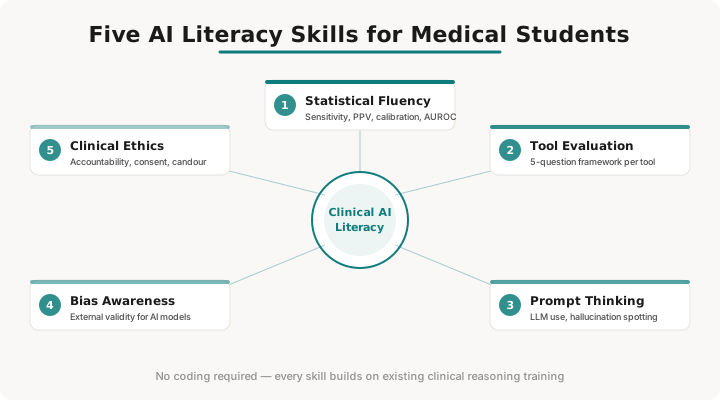
Skill One: Statistical Fluency
Statistics is the bridge between medical training and AI literacy. Every concept that matters in evaluating an AI tool has a direct analogue in concepts you are already taught: sensitivity and specificity, positive and negative predictive value, likelihood ratios, area under the ROC curve, calibration, and the difference between a screening test and a diagnostic one.
If those concepts feel solid, you already have the conceptual base for evaluating most clinical AI claims. If they feel fuzzy, the time to address that gap is now, not in your first year of practice when you are being asked to interpret an AI tool’s output on a real patient.
The practical version of this skill: when you read about a new clinical AI tool, you can immediately ask the right questions. What was the prevalence in the validation cohort? How does that compare to the population you would be applying it to? What does an 85% sensitivity mean clinically — and what is the specificity at that threshold? What is the post-test probability after a positive result?
If you can ask these questions and understand why the answers matter, you have AI literacy that will not date. The specific tools will change every two years; this reasoning will not.
Skill Two: Tool Evaluation
Medical training teaches you to evaluate evidence from clinical trials. AI tool evaluation uses overlapping but distinct criteria. The most useful framework to learn is one that maps onto how procurement actually happens in hospitals where you will work.
The questions a clinical AI tool must answer are: What specific clinical question does it address? What evidence supports its accuracy on the population you will use it on? What is its failure mode when conditions are unusual or data is poor? How does it integrate into your existing workflow? What happens when it is wrong?
This is not theoretical. Even as a medical student, you will encounter AI tools in clinical rotations — pulse oximeters with AI-derived metrics, image-flagging tools in radiology, decision-support pop-ups in the EMR, AI scribes used by your supervising consultants. Asking these five questions about each tool you encounter is exactly the practice you need.
A useful exercise: in every clinical rotation, identify one AI or AI-adjacent tool in use. Talk to a clinician who uses it. Ask what they think it gets right and what it gets wrong. Read the published validation data if available. Form your own view on whether you would adopt it in your future practice. Repeat for every rotation. By internship you will have built real evaluation skill.
Skill Three: Prompt Thinking
The single AI tool you will use most often in the next five years is a large language model. Whether or not LLMs are appropriate for clinical decision-making is a debated question; that you will use them daily for clinical workflow tasks is not.
Prompt thinking is the skill of expressing a clinical question in a way that produces useful, accurate output from an LLM — and recognising when the output is wrong even when it sounds confident.
This is harder than it looks. Medical students who use ChatGPT or Claude well can compress hours of literature search into minutes. Students who use them badly produce confidently wrong differential diagnoses and treatment plans, and do not realise it because the output sounds authoritative.
The skill has three components: structuring the prompt to give the model the clinical context it needs; recognising the kinds of clinical questions an LLM is good at versus the ones where it hallucinates; and verifying every clinically significant output against a source you can cite.
The practice that builds this skill is using LLMs deliberately on clinical content with feedback. Take a case from your textbook, ask the LLM for a differential diagnosis, then check it against the actual case discussion. Track where the LLM is reliable and where it fails. Over a hundred cases, you will develop calibrated intuition for when to trust the model and when not to.
Skill Four: Bias Awareness
Every AI model trained on data inherits the biases in that data. The biases that matter clinically are: demographic bias (the model performs worse on patients underrepresented in training data), measurement bias (the model is trained on a definition of disease that does not match the one in front of you), and deployment bias (the model performs differently in your clinical setting than in the one it was validated in).
These biases are not edge cases. They are the central reason a model that performs at 92% sensitivity in a published study performs at 76% sensitivity in your hospital.
The skill to build is the habit of asking, before trusting any AI tool, “Was this trained and validated on patients like the ones I see?” The honest answer in many cases is “no, or not enough.” That does not mean the tool is unusable. It means you weight its output differently and expect different failure modes.
A useful framing: AI bias is not a separate technical problem. It is the same external validity problem you already learn about for clinical trials. A trial conducted in middle-aged white American men does not necessarily generalise to young Indian women. An AI model trained on the same population has the same generalisation question. You already have the conceptual tools; apply them.
Skill Five: Clinical Ethics
The ethics question that AI raises in clinical practice is not whether AI should be used. It is who is responsible when the tool is wrong, what the patient should be told about the tool’s role in their care, and where the boundary sits between AI as decision support and AI as decision replacement.
These are professional questions, not technical ones. They map onto familiar territory: informed consent, professional accountability, the duty of candour when something goes wrong. The specifics shift when AI is involved, but the underlying ethical framework is the one you are already being taught.
The students who handle this best in their early careers are the ones who have thought through, in advance, what their position is. Are you willing to use an AI tool whose internal workings are opaque to you? Under what circumstances? What do you tell a patient if an AI tool was used in their diagnostic workup and you disagreed with its output? What do you do if a hospital pressures you to follow an AI recommendation against your clinical judgment?
These are not hypothetical questions. They will arrive in your first year of independent practice. The time to develop your answers is before they do.
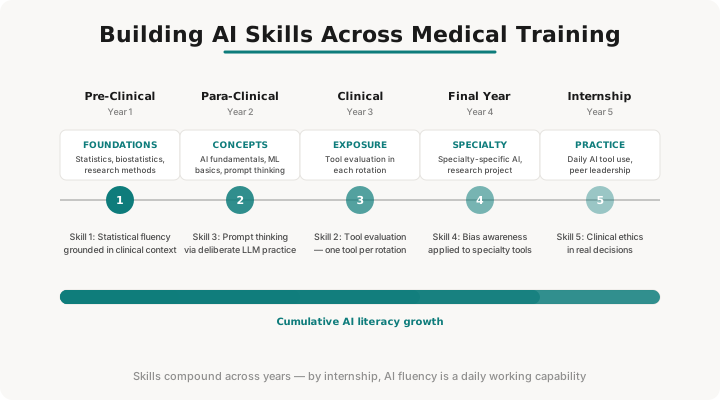
What Not to Worry About
It is worth being clear about what is not on this list and why.
You do not need to learn Python. The clinical AI tools you will use have user interfaces, not APIs you will call from a notebook. Coding is a useful skill for a small number of clinician-researchers who will go into hybrid careers; for the much larger number of clinicians who will be users of AI tools rather than builders, time spent on Python is time not spent on the five skills above.
You do not need to take a machine learning course. The mathematical foundations of how AI works are interesting and not essential for clinical use. A working clinician needs to understand what a model can and cannot do, not how gradient descent updates weights. The same way a working clinician needs to understand pharmacokinetics conceptually but does not need to compute volume of distribution from first principles.
You do not need to predict which specific AI tools will dominate in five years. Nobody knows. The skills above transfer across whatever the specific landscape ends up looking like.
The goal is not to become an AI expert. It is to become a doctor who is fluent enough with AI to lead its adoption in your eventual department, evaluate its outputs in your daily practice, and protect your patients from the categories of AI failure that bad clinical practice tolerates. That fluency is built five skills at a time, starting now.
Further Reading
Authoritative references
- WHO — Ethics and Governance of Artificial Intelligence for Health: the global framework for AI in clinical practice — essential reading for any student building an AI literacy base.
- EQUATOR Network: home of the TRIPOD-AI, CONSORT-AI and other reporting guidelines for AI studies in health.
- The BMJ: one of the most accessible peer-reviewed journals for understanding AI evidence in clinical contexts.
- NEJM AI: a peer-reviewed journal dedicated to AI in clinical medicine.
- PubMed: the gold-standard literature index for working through AI validation studies.
- HL7 FHIR: foundational data standard underpinning most modern clinical AI tools — worth understanding conceptually.
Related perspectives from MedAI Collective
- AI Foundations for Clinicians: Why Every Doctor Needs AI Literacy
- From Biostatistics to AI: A Clinician’s Bridge
- Prompt Thinking for Clinicians
- How to Evaluate a Clinical AI Tool — A Doctor’s Framework
- Types of Clinical Data — A Practical Taxonomy for AI Projects
- Sandbox Testing for Clinical AI: A Practical Guide
- Browse all perspectives
For students wanting structured starting points, The Practitioner Briefing is open to medical students at a discounted rate — the curriculum builds these five skills in two focused hours. For longer-form self-paced learning, the MedAI Collective perspectives library is updated weekly with practitioner-first AI content.