A senior histopathologist at a 350-bed multi-specialty hospital in Hyderabad spends the morning of every working day signing out around 40 cases — a mix of needle biopsies, surgical specimens, and cytology. The bottleneck is not the microscope. It is the reasoning, the comparison against similar cases seen years ago, the dictation, and the time to verify that the screen-printed report exactly matches what the slides actually show. By 2026, AI vendors have been pitching this physician variations of the same promise for at least three years: digitise the slides, let the AI flag what matters, save hours. Some of those promises are now true. Many are still vapour.
This article is a practitioner’s view of where AI in pathology actually stands in Indian labs — what works, what does not yet, and how a histopathologist or laboratory director should evaluate the tools currently on offer.
The Prerequisite: Whole-Slide Imaging
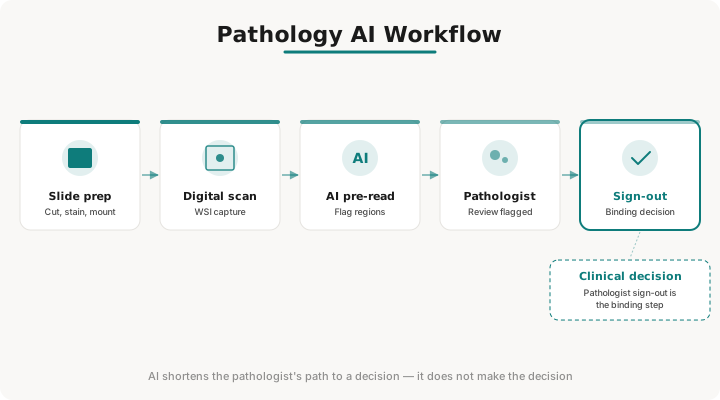
There is no AI pathology without digital pathology, and there is no digital pathology without whole-slide imaging infrastructure. The slides must be scanned at sufficient resolution, stored, viewed on calibrated displays, and routed through systems that pathologists actually want to use. In Indian labs in 2026, this is the gating step — not the AI.
The lab landscape is uneven. Apollo’s flagship centres, Tata Memorial, Manipal, and a handful of corporate chains have invested in modern slide scanners and PACS-style image storage. Most mid-size hospitals have either no scanner, a low-throughput scanner used selectively, or a scanner sitting in a cupboard because no one has had time to integrate it into routine workflow. Without consistent scanning, AI pathology pilots cannot run. Slides not in digital form are slides AI cannot see.
For a hospital considering AI pathology, the right first question is therefore not “which AI tool?” but “are we routinely scanning slides at diagnostic resolution, and is digital review a normal part of how pathologists already work?” If the honest answer is no, the AI conversation is premature.
The Five Use Cases With the Strongest Evidence
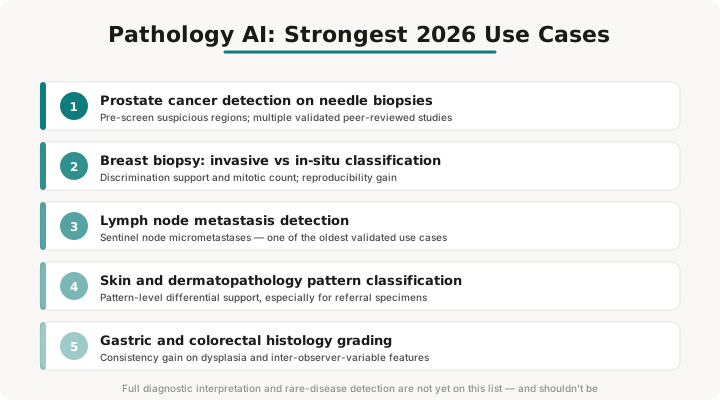
Where digital infrastructure exists, AI pathology has matured most in specific applications. The 2026 evidence base supports five use cases more strongly than others.
Prostate cancer detection on needle biopsies. Several validated models flag suspicious regions on prostate core biopsies with reasonable accuracy. Used as a pre-screen — directing the pathologist’s attention rather than replacing their read — these tools meaningfully reduce time to sign-out. Multiple peer-reviewed studies have replicated the finding across geographies; PubMed has an active and growing literature on this.
Breast biopsy assessment, including invasive vs in-situ classification. AI models can support discrimination between invasive ductal carcinoma and ductal carcinoma in-situ on H&E sections, and can quantify mitotic count more consistently than manual scoring. The benefit is most clear in centres with high biopsy throughput.
Lymph node metastasis detection. This is one of the older AI-pathology use cases — detection of micrometastases in sentinel lymph nodes for breast cancer. Models can scan large lymph node sections and highlight suspicious foci, which a pathologist might miss on rapid review.
Skin and dermatopathology pattern classification. Models trained on large dermatopathology archives can suggest pattern-level differentials (e.g., distinguishing benign nevus patterns from atypical melanocytic proliferations). The clinical role is decision support, not diagnosis — useful particularly in referral specimens.
Gastric and colorectal histology grading. Models support consistent grading of dysplasia and assessment of features that human inter-observer variability is known to be poor on. The benefit is reproducibility rather than accuracy improvement.
What is not yet supported by strong evidence: full diagnostic interpretation across specimens, integration of clinical history into diagnostic reasoning, or rare-disease detection where training data is necessarily thin.
The Indian Validation Question
AI pathology tools trained predominantly on Western specimens face a real question when deployed in India. The fixation protocols differ. The staining variation is greater. Patient demographics, disease prevalence, and clinical presentations shift the case mix. A model showing 92% sensitivity on Memorial Sloan Kettering archives does not automatically transfer to an Indian tertiary hospital’s slide set.
Several Indian groups — at Tata Memorial, AIIMS, and the Sree Chitra Tirunal Institute — have published validation work on Indian cohorts for specific use cases. ICMR-funded efforts have also begun to address this gap. When evaluating a vendor, the relevant question is not whether they have published a paper but whether the published validation includes specimens that look like yours. Different scanner, different stain, different population — all three reduce expected performance.
Workflow Integration: The Real Adoption Friction
AI pathology pilots succeed or fail on workflow integration far more often than on model accuracy. Three friction points recur:
Slide turnaround. AI tools require scanning before the pathologist sits down. If the workflow is read-from-glass-and-scan-only-if-archived, the AI tool will be perpetually waiting for slides it cannot access. The lab must reorganise so that scanning happens as part of routine slide preparation, not as a retrospective add-on.
Pathologist interface. Many AI pathology tools have their own viewer. Pathologists who already work in a specific PACS or LIS environment will not adopt a tool that requires switching contexts to a second viewer. The integration must put the AI flags into the viewer the pathologist already uses, or adoption stalls.
Sign-out workflow. If the AI flags a region, the pathologist still owns the diagnosis. The interaction pattern — accept, override, request second opinion — must be explicit and low-friction. Tools that produce flags but do not capture pathologist agreement create reporting ambiguity and audit problems.
These are not AI problems. They are operational design problems that an AI vendor can help with but cannot solve alone. The lab director’s involvement is essential.
How a Histopathologist Should Evaluate a Tool
Six questions surface most of what matters during procurement.
First, what specific question does the model answer? A tool that “uses AI for pathology” without a defined clinical role usually overpromises and underdelivers. Useful tools answer one question well.
Second, what was the validation cohort, and what was its similarity to your case mix? A vendor that cannot answer this in concrete terms has not done the work.
Third, how does the tool handle staining variation, scanner variation, and tissue artefact? Real labs have these problems daily; demonstration slides usually do not.
Fourth, how does it integrate with your LIS and your viewer? A separate viewer is a separate workflow problem.
Fifth, how does the tool handle uncertainty? Pathology is full of cases where the answer is “atypia, suggest further investigation” rather than a clean yes/no. AI tools that force binary outputs will be wrong on these cases more than tools that surface uncertainty explicitly.
Sixth, what is the regulatory and data residency position? CDSCO is the relevant Indian regulator for software-as-medical-device. The DPDP framework governs patient data; pathology slides count as patient data even when anonymised, depending on what they are linked to.
Where This Is Heading
Pathology is one of the specialties where AI is most likely to materially change the workflow over the next five years, not in the next year. The pieces — sufficient scanning capacity, validated models for specific use cases, integration standards, regulatory clarity — are arriving in sequence. By 2030, most tertiary cancer centres in India will be running AI-assisted pathology routinely. By 2035, it will be the norm for mid-size hospitals.
For 2026, the practical advice is: digitise first, pilot one validated use case, design the workflow integration carefully, and treat the AI as decision support that earns trust over months, not weeks.
Further Reading
Authoritative references
- WHO — Digital Health: global framework for digital health adoption that contextualises digital pathology infrastructure.
- CDSCO India: India’s medical device regulator and software-as-medical-device guidance.
- Indian Council of Medical Research (ICMR): clinical research and validation guidance applicable to pathology AI deployed on Indian populations.
- Ayushman Bharat Digital Mission (ABDM): the integration target most clinical AI tools will increasingly need to support.
- PubMed: primary literature index for pathology AI validation studies.
- HL7 FHIR: the data interchange standard relevant to integrating pathology AI with LIS and EMR.
Related perspectives from MedAI Collective
- Why Radiology AI Works in Tier 1 Hospitals But Stalls Everywhere Else
- How to Evaluate a Clinical AI Tool — A Doctor’s Framework
- AI in Cardiology: ECG Interpretation Tools for Indian Clinicians
- Sandbox Testing for Clinical AI: A Practical Guide
- Types of Clinical Data — A Practical Taxonomy for AI Projects
- Browse all perspectives
If your lab is evaluating AI pathology tools and would benefit from a vendor-neutral framework, MedAI Collective Advisory runs structured AI readiness sessions for pathology and other specialties. Laboratory directors can also join an upcoming Practitioner Briefing.