A junior physician in a tier-2 Indian city receives a 12-lead ECG flagged by an AI tool as “anterior STEMI — high probability.” The patient is 38, presenting with epigastric pain, and the on-call cardiologist is two hours away. Does the physician activate the cath lab? Treat for gastritis? Repeat the ECG?
This is no longer a hypothetical. AI-based ECG interpretation has moved from research papers to OPD walls, smartphone apps, and the resting-ECG machines being installed in district hospitals. Some of these tools are genuinely useful. Some are reskinned versions of the same Marquette and GE algorithms cardiologists have been ignoring for thirty years. Telling them apart is now a clinical skill.
This article is a practitioner’s guide to the AI-ECG landscape as it actually exists for Indian cardiologists in 2026 — what the technology is doing, where the evidence is strong, where it’s thin, and how to evaluate any tool before letting it into your department.
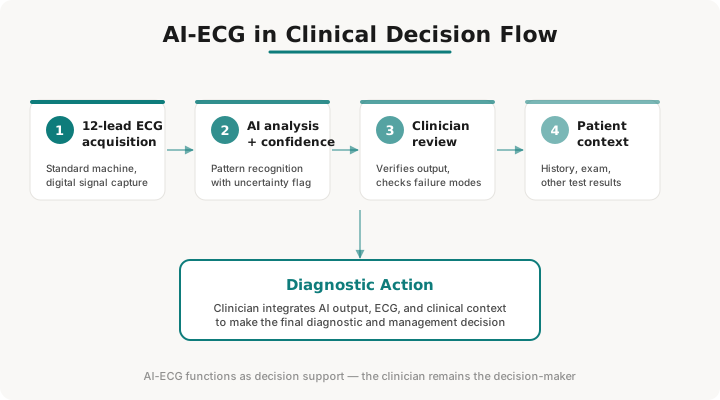
What “AI-ECG” Actually Means in 2026
The term AI-ECG covers at least three distinct technologies that share little beyond marketing copy.
The first is rule-based interpretation, which has existed since the 1980s. The Glasgow algorithm, the Marquette 12SL system, and others apply hand-coded rules — if QRS duration exceeds 120 ms and there is no left bundle branch block pattern, label it as right bundle branch block. These systems are reliable for the things they were designed to detect and unreliable for everything else. Most cardiologists treat their output as a starting suggestion, not a diagnosis.
The second is deep learning on the ECG waveform itself. A convolutional neural network is trained on millions of ECGs paired with outcomes — an expert cardiologist’s diagnosis, an echocardiographic finding, a future event such as atrial fibrillation. The network learns to predict the outcome directly from the raw signal. This is what gives modern AI-ECG its power: a deep learning model can detect left ventricular dysfunction from a 12-lead ECG with reasonable accuracy, identify silent atrial fibrillation, and flag patients at elevated risk of future heart failure. The Mayo Clinic and Cleveland Clinic have published extensively on this; several Indian groups, including AIIMS Delhi and Sree Chitra Tirunal Institute, have replicated key findings on Indian populations.
The third is smartphone and patch-based ECG with AI — single-lead or six-lead recordings from a wrist device or chest patch, where AI fills the role of the radiology read. AliveCor’s Kardia, Apple Watch’s atrial fibrillation detection, and a growing number of Indian-built equivalents fall into this category.
Each of these is “AI-ECG.” They are not interchangeable. A study showing that deep learning on 12-lead waveforms identifies LV dysfunction with 85% sensitivity tells you nothing about whether a smartphone single-lead device will do the same. Read the methods, not the headline.
The Five Use Cases With the Strongest Evidence
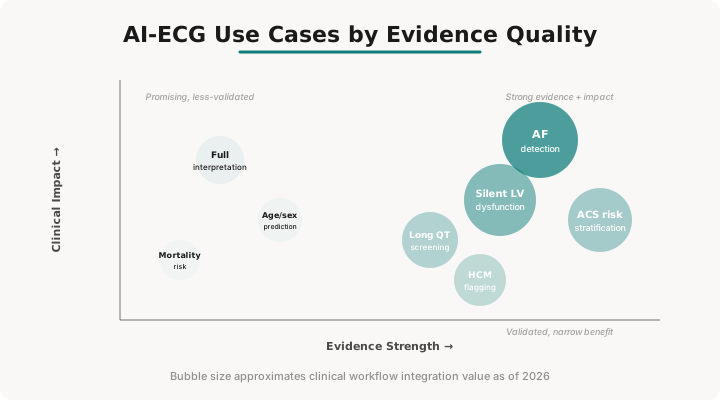
If you are a cardiologist trying to decide where AI-ECG actually earns its place in your practice, these are the use cases where the evidence is strongest as of mid-2026.
Atrial fibrillation detection. The most mature use case. Wearable and patch-based AI-ECG meaningfully outperforms intermittent clinic ECGs at catching paroxysmal AF. The clinical question is no longer whether it works — it is what to do with the increased detection rate, particularly in older asymptomatic patients where stroke prevention benefit must be weighed against bleeding risk. India’s stroke burden makes this a high-value tool when used in the right population.
Silent left ventricular dysfunction. Deep learning models trained on 12-lead ECG can identify reduced ejection fraction with reported sensitivity in the 80–90% range. The use case is screening — flagging patients who would benefit from echocardiography. In an Indian context, where echocardiography is not universally available, this is genuinely useful as a triage tool.
Long QT and high-risk arrhythmia phenotypes. Models can identify subtle QT prolongation patterns and other repolarisation abnormalities better than rule-based systems, particularly important in drug safety contexts where many commonly prescribed medications affect repolarisation.
Hypertrophic cardiomyopathy. Several validated models flag ECG patterns associated with HCM. Useful as a screening tool in athletes and family members of affected patients.
Acute coronary syndrome risk stratification. AI models incorporating ECG and clinical features outperform troponin alone and clinical scores alone for early ACS risk stratification. Most useful in chest-pain pathways at hospitals with high volume.
Note what is not on this list: full diagnostic interpretation of the 12-lead ECG. No current AI-ECG system reliably replaces a cardiologist’s read across the full diagnostic spectrum. They are tools for specific questions, not general readers.
The Indian Context: What Changes the Calculation
Three factors specific to Indian cardiology practice change how to think about AI-ECG adoption.
Population validation matters more than usual. Indian patients have distinct ECG patterns at baseline — early repolarisation prevalence, QTc distributions, and demographic patterns differ from the US and European cohorts most AI-ECG models are trained on. A model showing 90% sensitivity on a Mayo Clinic dataset may show 78% on an AIIMS dataset. Before adopting any tool, ask the vendor for validation data on Indian populations. If they cannot provide it, treat the published metrics as upper bounds.
Workflow integration is harder. Many Indian hospitals run a heterogeneous mix of ECG hardware — Philips, BPL, Schiller, Mortara, plus older units still in service. A cloud-based AI tool that requires structured digital ECG input may not integrate cleanly with paper-printed traces from a 15-year-old machine. Ask explicitly about input formats and the manual upload workflow before assuming the tool will fit.
Regulatory clarity is evolving. As of 2026, India’s CDSCO has issued guidance on software as a medical device but specific AI-ECG approval pathways are still maturing. ABDM integration adds another layer — if the tool needs to share data, it must speak FHIR and respect the consent layer. None of this is a barrier to clinical use, but it affects procurement timelines and vendor selection.
Six Questions Before Procurement
If a department head is evaluating an AI-ECG tool, these are the six questions that surface most of the issues that matter clinically and operationally.
First, what specific clinical question does this tool answer? A tool advertised as “AI for ECG interpretation” without a clear primary use case is usually solving multiple things badly. Ask for the one or two outcomes it is most reliable for, and check whether those match your clinical needs.
Second, what was the validation cohort, and was Indian data included? A model validated on 200,000 European patients but tested on 1,500 Indian patients is qualitatively different from one trained primarily on Indian data. Both can be useful; the difference matters for the failure modes you should expect.
Third, what is the failure mode behaviour? When the model is uncertain, does it flag the case for clinician review, output a low-confidence prediction, or silently produce an answer? Tools that suppress uncertainty are dangerous in clinical use.
Fourth, how does it handle bundle branch block, paced rhythms, and atrial fibrillation? These are the conditions on which most AI-ECG tools degrade significantly. A tool that performs well on normal-rhythm 12-leads but produces unreliable output on AF or paced rhythms needs explicit guardrails in workflow.
Fifth, what is the integration burden? Cloud upload, on-premise install, EMR plugin — each implies different IT, security, and ongoing-cost commitments. The cheapest licence may carry the most expensive deployment.
Sixth, what is the exit pathway? If the tool fails to deliver value, can your department remove it cleanly? Vendor lock-in is a real risk when AI tools become embedded in daily workflows and clinician habits.
A Reasonable Adoption Path
For a hospital cardiology department considering AI-ECG, the reasonable path is sequential, not all-at-once. Start with a single high-evidence use case — most often AF screening or LV dysfunction triage — run a 60–90 day evaluation with explicit success metrics, and only then expand.
The tool should not replace clinical judgment. It should answer one question that, answered reliably, changes a clinical decision your team would otherwise make differently. If you cannot articulate that question and that decision, the tool is not ready for your department, even if the vendor’s pitch deck is excellent.
AI-ECG is one of the genuinely useful clinical AI categories. The risk is not adopting it badly; it is adopting it without the discipline that makes the difference between a tool that improves care and one that adds noise to an already-busy department.
Further Reading
Authoritative references
- WHO — Ethics and Governance of Artificial Intelligence for Health: the global framework for safe and equitable deployment of AI in clinical settings.
- CDSCO India: India’s medical device regulator — relevant to software-as-medical-device classification of AI-ECG and other clinical AI tools.
- Ayushman Bharat Digital Mission (ABDM): India’s national digital health stack — the integration target most clinical AI tools will increasingly need to support.
- HL7 FHIR: the data interchange standard most modern clinical AI tools speak to.
- Indian Council of Medical Research (ICMR): clinical research and validation guidance applicable to AI tools deployed on Indian populations.
- PubMed: the primary literature index for AI-ECG validation studies and clinical evidence.
Related perspectives from MedAI Collective
- How to Evaluate a Clinical AI Tool — A Doctor’s Framework
- AI Foundations for Clinicians: Why Every Doctor Needs AI Literacy
- From Biostatistics to AI: A Clinician’s Bridge
- Sandbox Testing for Clinical AI: A Practical Guide
- AI Readiness Checklist for 100–300 Bed Hospitals in India
- Browse all perspectives
If your department is evaluating AI tools and would benefit from a vendor-neutral framework, the MedAI Collective Advisory runs structured AI readiness sessions for cardiology and other specialties — covering exactly the questions above. Practising clinicians and trainees can also join an upcoming Practitioner Briefing.