By 2030, the medical students starting clinical rotations in 2026 will be in early independent practice. The AI tools they will use daily then do not yet exist in mature form. The curriculum that should prepare them for that practice does not yet exist in most Indian medical colleges. And the time they have available — between clinical postings, exams, family commitments, and the rest of life — is finite.
This is a 12-month self-study roadmap for medical students who want to build real AI literacy without abandoning their clinical training. It is built around the assumption that they are not going to become machine learning engineers. They are going to be clinicians who use AI tools well, evaluate them critically, and lead their adoption in their eventual departments. That is a different curriculum from a computer science one — and a more useful one for most students.
The roadmap is structured in four 3-month phases. Each phase has specific objectives, resources, and a small project that consolidates the learning. The total commitment is approximately 4–6 hours per week — sustainable alongside clinical postings if treated as a routine.
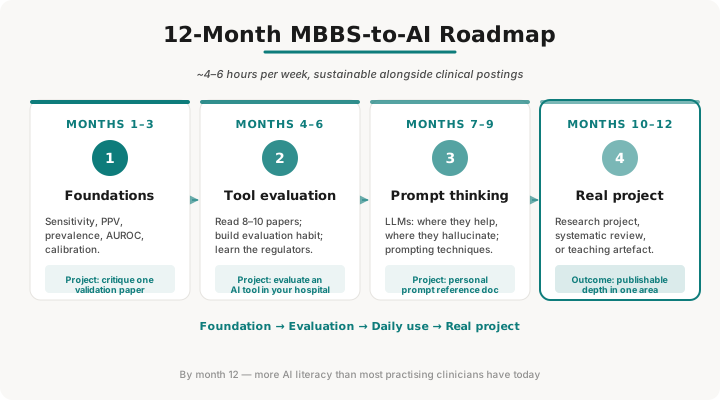
Months 1–3: Foundations and Statistical Fluency
The first phase is unglamorous and essential. AI literacy rests on statistical literacy. Students who skip this end up able to use AI vocabulary without understanding what the words mean clinically.
Core concepts to build solid intuition on:
- Sensitivity, specificity, positive and negative predictive value, likelihood ratios
- Prevalence and how it shifts post-test probabilities
- Calibration vs discrimination
- ROC curves and AUROC, understood as a trade-off across thresholds
- The difference between accuracy and the metrics that actually matter in low-prevalence problems
- External validity — why a model that works in one setting may not work in another
Recommended resources:
- The BMJ statistics archives are accessible to a clinical audience and link concepts to clinical examples.
- Trisha Greenhalgh’s How to Read a Paper — a foundational text that maps to AI literature almost directly.
- For visual reasoning: practising on real diagnostic test papers where the numbers are real and the clinical context is meaningful.
Phase 1 project: Pick a published AI validation study on a topic you are interested in. Work through the paper, identifying: prevalence in the study cohort, sensitivity and specificity at the chosen threshold, the PPV implied by those numbers, the comparator used, and the external validity threats. Write a one-page critical appraisal in your own words. This single exercise consolidates more than dozens of YouTube videos.
Months 4–6: Clinical AI Evaluation and Reading Literature
By month four, with statistical foundations in place, the second phase shifts to engagement with actual clinical AI tools and literature.
Goals for this phase:
- Read 8–10 AI clinical validation papers across different specialties
- Build a personal mental catalogue of the use cases where AI is mature vs the use cases where it is hype
- Develop the habit of asking, for any AI tool encountered in clinical posting, the five core evaluation questions (specific clinical role, validation cohort similarity, failure modes, workflow integration, exit pathway)
- Understand the regulatory landscape: CDSCO in India, FDA in the US, MHRA in the UK — and what their clearances do and do not mean
Recommended resources:
- PubMed for systematic reading. Set up alerts for AI clinical validation papers in 2–3 specialties of interest.
- NEJM AI is a relatively new peer-reviewed journal specifically for AI in clinical medicine; accessible writing and high editorial standards.
- The EQUATOR Network reporting guidelines (TRIPOD-AI, CONSORT-AI) are reference material for how AI studies should be reported — and therefore how to read them.
- WHO Ethics and Governance of AI for Health is the global framework worth understanding.
Phase 2 project: Pick a specific clinical AI tool — one in use at your teaching hospital, ideally — and produce a structured evaluation document. Talk to a clinician who uses it about what they think it gets right and what it gets wrong. Read the published validation. Form your own view. This is the practice that builds real evaluation skill.
Months 7–9: Prompt Thinking, LLMs, and AI in Practice
By month seven, the third phase moves into the LLM territory that will dominate day-to-day AI use for most clinicians. This is the most rapidly evolving area — what is true in 2026 may shift by 2027 — but the underlying skills transfer.
Goals for this phase:
- Develop calibrated intuition about what LLMs are good at vs where they hallucinate
- Build practical prompting skills — role and context, step-by-step reasoning, uncertainty flags, iterative follow-up
- Understand the data privacy boundaries: what can be entered into a public LLM, what cannot, and why
- Get comfortable using LLMs for legitimate clinical workflow tasks (literature summarisation, patient communication drafting, concept explanation) while recognising the verification responsibility
Recommended resources:
- Hands-on practice is the only path. Spend 30 minutes weekly on clinical content — a case from your textbook, ask the LLM for a differential, then check it against the actual case discussion. Track where it is reliable, where it fails.
- Read 2–3 essays per month on responsible LLM use in clinical contexts. Quality writing on this topic is increasingly available.
Phase 3 project: Build a small reference document of “prompts that work” for tasks you actually do — note-taking, study revision, literature orientation, drafting patient explanations. This is genuinely useful as a working artefact and forces explicit thinking about what works and what does not.
Months 10–12: A Real Research or Evaluation Project
The final phase is where the learning consolidates into something that is yours and that you can talk about credibly.
Goal: complete one substantive AI-related project. The specific topic matters less than the depth — better to do one thing seriously than three things superficially.
Project options that work for students:
- A clinical AI evaluation study at your teaching hospital. Pick one tool in use, design a small evaluation (could be retrospective chart review against AI output), execute under faculty supervision. If results are interesting, write up for a journal — many Indian journals publish student-led work.
- A systematic review of AI in a specialty area. Pick a narrow specialty AI application, work through the literature systematically using reporting guidelines, produce a structured review. Useful for the specialty interest and demonstrably rigorous.
- A teaching artefact for peers. Build the curriculum you wish you had — a presentation, set of case discussions, or short tutorial on a specific AI topic for medical students. Teach it to your peers. Teaching is the deepest test of understanding.
- A clinician-supervised AI prototype. If you have programming background, build a working prototype of a clinical AI tool for a narrow use case under faculty supervision. Most students lack the time for this; those who have it can do meaningful work.
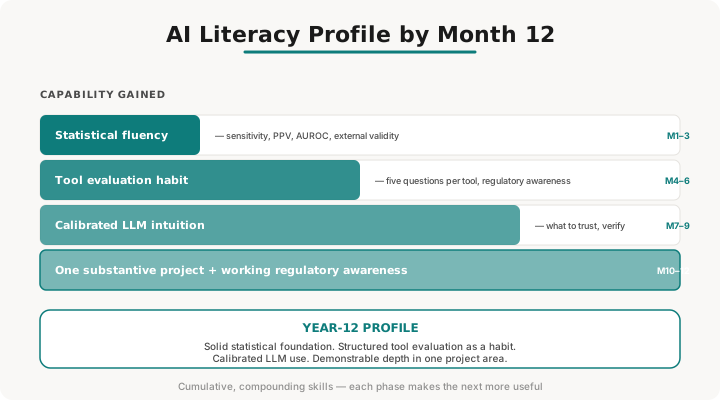
By month twelve, the student who has done this work seriously has: solid statistical foundations, the habit of structured AI tool evaluation, calibrated intuition for LLMs in clinical use, and one project that demonstrates depth. That is meaningful AI literacy. It is also more than most practising clinicians have.
What This Roadmap Is Not
It is not a path to becoming an AI researcher. Students who want that should pursue formal training — a research year, a fellowship, or a structured technical course. The roadmap above is for clinicians who will use AI tools well, not build them.
It is not a substitute for clinical training. The time commitment is deliberately modest — 4–6 hours per week — because clinical learning is the priority. Students who let AI study cannibalise their clinical postings will end up with neither.
It is not the only path. Students with different starting points, different specialty interests, and different time availability will adapt this. The general structure — foundations first, evaluation skills second, practical LLM use third, project fourth — is what matters more than the specific resources.
Further Reading
Authoritative references
- WHO — Ethics and Governance of AI for Health: the global framework for AI in clinical practice.
- EQUATOR Network: TRIPOD-AI, CONSORT-AI and reporting guidelines for AI studies.
- The BMJ: accessible peer-reviewed source for statistical and clinical reasoning.
- NEJM AI: peer-reviewed journal dedicated to AI in clinical medicine.
- PubMed: primary literature index for AI validation studies.
- HL7 FHIR: the data interchange standard underpinning modern clinical AI infrastructure.
Related perspectives from MedAI Collective
- AI Skills Every Medical Student Should Build Before Internship
- AI Foundations for Clinicians: Why Every Doctor Needs AI Literacy
- From Biostatistics to AI: A Clinician’s Bridge
- Prompt Thinking for Clinicians
- How to Evaluate a Clinical AI Tool — A Doctor’s Framework
- Browse all perspectives
For students who prefer a structured group format, The Practitioner Briefing is open to medical students at a discounted rate and covers many of the foundations in this roadmap in two focused hours. The MedAI Collective perspectives library is updated weekly with new practitioner-first content.