Every few months, a new AI tool arrives at your hospital with a polished demo, an enthusiastic vendor, and a procurement committee that has already half-decided. The slides promise improved diagnostic accuracy, reduced turnaround times, and better patient outcomes. The administration sees efficiency gains. The IT department sees a manageable integration project. But somewhere in this process, the people who will actually use the tool — the doctors, the radiologists, the pathologists, the intensivists — are asked for their opinion only after the decision has effectively been made. This is backwards. And it is one of the most consistent patterns in how Indian hospitals adopt clinical AI today.
The problem is not that hospitals are buying AI tools. Many of these tools are genuinely useful, backed by credible research, and capable of improving clinical workflows. The problem is that the evaluation process rarely includes the clinical perspective in a structured, meaningful way. Doctors are shown a product demonstration, asked if it looks reasonable, and their nod is interpreted as clinical endorsement. What is missing is a rigorous framework — a set of specific, practical questions that any clinician can ask to determine whether an AI tool is genuinely ready for their department, their patients, and their workflow.
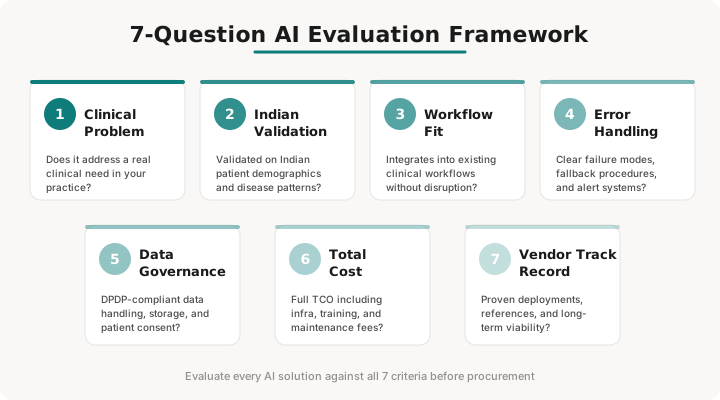
This article provides that framework. It is built around seven questions that every doctor should ask before an AI tool enters their clinical practice.
Why Clinicians Must Lead the Evaluation
Before diving into the seven questions, it is worth understanding why this framework needs to come from doctors rather than from hospital administration, IT departments, or the vendors themselves.
Hospital administrators evaluate AI tools through the lens of operational efficiency and return on investment. These are legitimate concerns, but they are incomplete. An AI tool might promise to reduce reporting turnaround time by 40 per cent, which looks excellent on a business case slide. But if that tool generates findings in a format that does not match how the clinician thinks about the problem — if it flags abnormalities without clinical context, or if it produces outputs that require significant interpretation before they become actionable — the promised efficiency gain evaporates. The clinician spends just as long on the case, now with the added step of reconciling the AI output with their own assessment.
IT departments evaluate integration feasibility: can the tool connect to the hospital information system, does it support HL7 or FHIR standards, what are the server requirements? These are necessary but insufficient questions. A tool that integrates perfectly with the hospital’s technical infrastructure but disrupts the clinical workflow is a tool that will not be used. And a tool that is not used is, regardless of its technical elegance, a failed investment.
Vendors, naturally, present their product in the most favourable light. They lead with performance metrics from their best validation studies, demonstrate the tool under ideal conditions, and emphasise use cases where the algorithm performs strongest. This is not dishonesty — it is marketing. But it means that the clinical limitations, the edge cases, the failure modes, and the workflow friction points are rarely surfaced during the sales process. Only someone who understands the daily reality of clinical practice can ask the questions that reveal these gaps.
The clinician is the only person in the procurement conversation who understands both the clinical problem and the clinical workflow. That makes the clinician the only person who can evaluate whether an AI tool will actually work in practice.
1. What clinical problem does this tool actually solve?
This is the most fundamental question, and it is remarkable how often it goes unasked. Many AI tools are presented with broad, aspirational claims: they are “AI-powered diagnostic assistants” or “intelligent clinical decision support systems.” These descriptions sound impressive but communicate almost nothing about what the tool actually does in a clinical setting.
Specificity matters enormously. There is a vast difference between an AI tool that detects diabetic retinopathy on fundus photographs and one that claims to “assist with ophthalmic diagnosis.” The first describes a concrete clinical task with measurable outcomes. The second could mean almost anything. When a vendor presents their tool, the first question should be: what specific clinical decision does this tool help me make, and for which specific patient population?
A well-defined AI tool should be able to articulate its clinical scope in a single sentence. It detects pulmonary nodules on chest CT scans. It identifies atrial fibrillation on single-lead ECG tracings. It predicts sepsis risk in ICU patients using vital signs and laboratory data. It triages chest X-rays for tuberculosis in outpatient screening programmes. Each of these is a concrete, testable claim. If the vendor cannot describe their tool’s clinical function with this level of specificity, that is a significant red flag.
Additionally, ask whether the problem the tool solves is a problem your department actually has. An AI tool for detecting rare cardiac conditions may be technically impressive but clinically irrelevant in a department where the bottleneck is high-volume routine screening. The best AI tool for your department is not the most sophisticated one — it is the one that addresses your most pressing workflow problem.
2. What evidence supports its performance in Indian patient populations?
Clinical AI tools are trained on data, and the composition of that training data determines where the algorithm works well and where it does not. This is not a theoretical concern. It is a documented, measurable source of clinical error.
Many AI tools available in India were developed and validated primarily on Western patient populations. Dermatology AI trained predominantly on lighter skin tones performs poorly on darker skin. Chest X-ray algorithms trained on datasets from North American hospitals may not account for the higher prevalence of tuberculosis, silicosis, or post-tubercular sequelae common in Indian populations. Retinal imaging algorithms validated in European diabetic populations may not generalise to the spectrum of diabetic eye disease seen in Indian patients, where presentation patterns, disease severity at first detection, and comorbidity profiles differ significantly.
The questions to ask are concrete. What datasets was this algorithm trained on? What was the demographic composition of the training and validation data — age distribution, sex ratio, geographic origin, disease prevalence? Has the tool been validated on Indian patient data, and if so, from which hospitals, in which regions, and with what sample sizes? What were the sensitivity and specificity numbers in those Indian validation studies, and how do they compare to the numbers from the original development dataset?
If the vendor does not have Indian validation data, that does not necessarily mean the tool is useless. But it does mean that the performance claims on the marketing materials may not apply to your patients. In that case, ask whether the vendor is willing to support a local validation study at your hospital before full deployment. Any credible vendor should welcome this.
An algorithm validated exclusively on Western patient data is not a validated algorithm for Indian clinical practice. It is a hypothesis that needs testing.
3. How does it integrate into existing clinical workflows?
Workflow integration is where most AI deployments succeed or fail, and it is the area where the gap between the vendor’s demonstration and the clinician’s reality is widest.
During a product demo, the AI tool is shown in isolation: a clean interface, a single patient case, a clear output. In reality, the clinician is managing dozens of cases simultaneously, switching between systems, responding to interruptions, and operating under time pressure. The question is not whether the AI tool works when given full attention in a controlled demonstration. The question is whether it works when embedded in the chaos of actual clinical practice.
Ask specifically how the tool delivers its output. Does it integrate directly into your existing EMR or PACS, appearing within the systems you already use? Or does it require logging into a separate portal, a different browser tab, a standalone application? Every additional click, every context switch, every separate login adds friction. In high-volume clinical settings, that friction compounds across hundreds of cases and eventually becomes the reason the tool is abandoned.
Ask how the tool handles the timing of its output. In radiology, an AI tool that takes fifteen minutes to process a study is useless for a radiologist who reads each case in two to three minutes. In the ICU, a sepsis prediction tool that updates once per hour misses the rapid deterioration that clinicians need to catch in real time. The tool’s processing speed must match the tempo of clinical decision-making in your specific setting.
Ask about the output format. Does the AI produce a probability score, a binary classification, a visual overlay, a structured report, or a simple alert? Is the output self-explanatory, or does it require interpretation? Can it be incorporated directly into the clinical note or radiology report, or does it need to be manually transcribed? The ideal AI output is one that fits seamlessly into the documentation you already produce, without requiring additional effort to translate.
4. What happens when the AI is wrong?
Every AI tool makes errors. This is not a flaw in any specific product — it is an inherent characteristic of probabilistic systems. No algorithm achieves 100 per cent sensitivity and 100 per cent specificity. The important question is not whether the tool makes errors, but how those errors are handled in clinical practice.
Start with the error profile. Ask the vendor for the tool’s false positive and false negative rates, ideally from the Indian validation data discussed in question two. Understand what types of errors the tool makes. Does it tend to over-call findings, generating a high volume of false positives that require time-consuming review? Or does it tend to miss subtle findings, creating a false sense of security? The clinical consequences of these two error types are very different, and your tolerance for each depends on the clinical context.
Then ask about the fallback mechanism. When the AI produces an output that the clinician disagrees with, what happens next? Is there a clear, documented workflow for overriding the AI? Can the clinician easily dismiss a false positive without it being flagged as an “ignored alert” in an audit trail? Conversely, if the clinician identifies a finding that the AI missed, is there a mechanism to report this back to the vendor for algorithm improvement?
The liability question is equally important and often avoided. If a clinician acts on an AI recommendation that turns out to be incorrect, who bears the clinical and legal responsibility? In India, the regulatory framework for AI-assisted clinical decisions is still evolving. The Central Drugs Standard Control Organisation (CDSCO) released a draft guidance document on Medical Device Software in October 2025, but finalised regulation and legal precedents are still sparse. Until the regulatory landscape is clearer, the practical answer is that the treating physician bears the responsibility. This means the AI tool must be positioned as a clinical decision support system — one input among many — not as an autonomous diagnostic agent.
Never evaluate an AI tool only by its best performance. Evaluate it by its failure modes, because those are what you will encounter in practice.
5. What data does it need, and where does that data go?
Clinical AI tools require patient data to function. The nature, volume, and destination of that data should be one of the first things a clinician evaluates, not one of the last.
Begin with input requirements. What specific data does the tool need to produce its output? A radiology AI tool may need DICOM images, patient demographics, and clinical history. A clinical decision support tool may require laboratory values, vital signs, medication lists, and diagnostic codes. Understand exactly what data is being extracted from your hospital systems and fed into the AI engine. More data is not inherently better — every additional data point is an additional privacy exposure.
Then ask where the data goes. Is the AI processing performed on-premise, within your hospital’s own servers, or is data transmitted to an external cloud server? If cloud-based, where are those servers located? Are they within India, complying with data localisation norms, or are they hosted overseas? Who has access to the data once it reaches the cloud — the AI vendor’s engineering team, their data scientists, third-party infrastructure providers?
India’s data protection landscape is evolving. The Digital Information Security in Healthcare Act (DISHA) was drafted by MoHFW in 2018 but has not been enacted into law; its principles around health data sovereignty are expected to be addressed within the broader Digital Personal Data Protection Act, 2023, which establishes requirements around data processing, storage, and cross-border transfer. Any AI tool deployed in an Indian hospital should be able to demonstrate compliance with these frameworks, or at minimum, articulate a clear plan for compliance as the regulations take effect.
Ask whether patient data is used to improve the AI algorithm. Many AI tools continuously learn from the data they process, using it to retrain and refine their models. This is a legitimate engineering practice, but it raises consent and ownership questions. Are patients informed that their data may be used for algorithm development? Is the data anonymised before being used for training? Does the hospital retain any intellectual property rights over insights generated from its patient data? These questions are particularly important for large hospitals generating high-volume, diverse datasets that are extremely valuable for AI development.
6. What does the total cost of ownership look like?
The licence fee for an AI tool is often the smallest component of its true cost. Clinicians involved in evaluation should insist on understanding the full financial picture, because the hidden costs are frequently the ones that determine whether the tool remains sustainable beyond the pilot phase.
Start with the direct costs. What is the licensing model — per study, per user, per department, or a flat annual fee? Is there a minimum commitment period? What happens to your data and your access if you decide not to renew? Are there additional charges for upgrades, new algorithm versions, or expanded clinical use cases?
Then consider the infrastructure costs. Does the tool require new hardware — GPU servers for on-premise deployment, upgraded network equipment for cloud-based processing, new workstations for the clinical interface? What are the ongoing hosting or cloud computing costs? Many cloud-based AI tools charge per transaction or per compute hour, and these costs can scale quickly in high-volume departments.
The often-overlooked cost is workflow disruption during implementation. Deploying an AI tool requires training — not just a one-hour demonstration, but sustained education for every clinician who will use the system. It requires workflow redesign — adjusting protocols, updating standard operating procedures, modifying report templates. It requires IT resources for integration, testing, troubleshooting, and ongoing maintenance. And during the transition period, clinical productivity typically drops before it improves. A department that normally processes 200 cases per day might process 160 during the first month of AI deployment as clinicians adjust to the new workflow.
Ask the vendor to provide a total cost of ownership estimate that includes all of these components over a three-year period. Compare this against the expected clinical and operational benefits. If the vendor cannot provide a transparent cost breakdown, or if the analysis shows that the benefits are marginal relative to the investment, that information should be surfaced during the procurement discussion.
7. What does the vendor’s track record look like in India?
The final question moves from the product to the organisation behind it. An AI tool is not a one-time purchase. It is an ongoing relationship with a vendor who must provide updates, support, regulatory compliance, and continuous improvement for as long as the tool is in clinical use.
Ask about the vendor’s presence in India. Do they have a local team, or is all support routed through an overseas headquarters? In a country where hospital IT infrastructure varies enormously and internet reliability is inconsistent, having local support engineers who understand the Indian healthcare environment is not a luxury — it is a practical necessity. When the integration breaks at 2 AM and the night shift radiologist cannot access AI outputs, a support team in a different time zone is of limited value.
Ask for reference hospitals. Which Indian hospitals are currently using this tool in clinical production — not in pilot programmes or research collaborations, but in daily clinical practice? Can the vendor connect you with clinicians at those hospitals who can speak candidly about their experience? Reference conversations with peer clinicians are among the most valuable inputs in any evaluation process. They reveal the real-world experience that no sales presentation can capture: how long the integration actually took, what unexpected problems arose, how responsive the vendor was when things went wrong, and whether the tool delivered on its promises after the initial excitement faded.
Examine the vendor’s regulatory track record. Have they obtained CDSCO approvals for their products in India? Are they compliant with the Medical Device Rules, 2017? Do they carry appropriate professional indemnity insurance? Have they been involved in any regulatory actions or adverse event reports? In a market where many AI tools operate in regulatory grey areas, a vendor with clear, documented regulatory compliance demonstrates a level of seriousness about patient safety that should be a baseline expectation.
Finally, assess the vendor’s financial stability. AI startups in Indian healthtech have experienced significant funding volatility in recent years. A tool from a vendor that runs out of funding and shuts down leaves the hospital with an orphaned product, no support, and the need to restart the evaluation and procurement process from scratch. While no one can predict the future of any company, understanding the vendor’s funding status, revenue model, and customer base gives you some indication of their staying power.
You are not just buying software. You are entering a clinical partnership. Evaluate the partner as rigorously as you evaluate the product.
Putting the Framework Into Practice
Knowing the right questions is necessary but not sufficient. The value of this framework depends on how and when it is used in the actual procurement process.
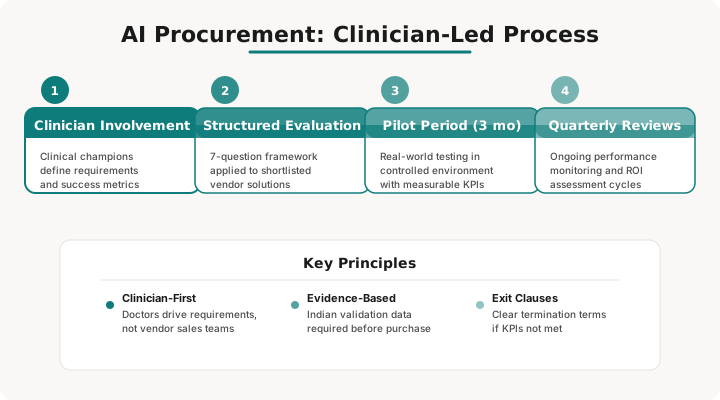
The most important intervention is timing. Clinicians should be involved from the very beginning of the evaluation process, not brought in after a shortlist has already been drawn up. If you are a department head and you learn that the administration is considering an AI tool for your department, request a seat at the evaluation table before any vendor demonstrations occur. Frame it not as resistance to technology but as clinical due diligence — the same standard of evidence-based evaluation that you would apply to any new clinical intervention.
When the vendor presents, bring this framework in writing. Literally hand them the seven questions and ask them to respond to each one in writing, with supporting documentation. A vendor who can answer all seven questions thoroughly and transparently is a vendor worth taking seriously. A vendor who deflects, provides vague responses, or suggests that these questions are unnecessary is telling you something important about how they will behave as a partner after the contract is signed.
Build an evaluation scorecard. For each of the seven questions, rate the vendor’s response on a scale of one to five, with clear criteria for each rating. Share this scorecard with other clinicians in your department and ask them to complete it independently after the vendor presentation. This structured approach replaces the subjective impression that often drives procurement decisions — “the demo looked good” — with a documented, reproducible assessment that can be defended and discussed.
Insist on a pilot before a purchase. No AI tool should be deployed at scale in a clinical department without a structured pilot period of at least three months. During the pilot, track specific metrics that matter to your clinical practice: how many cases were processed, how many AI outputs were clinically useful, how many were ignored, how many errors were identified, and how much time the tool added to or saved from the clinical workflow. If the pilot data does not demonstrate clear clinical value, the tool should not proceed to full deployment regardless of the contract terms.
Finally, establish an ongoing review mechanism. AI tools are not static. Algorithms are updated, clinical workflows evolve, patient populations shift, and regulatory requirements change. Schedule quarterly reviews where clinicians assess whether the tool continues to deliver value, whether new issues have emerged, and whether the vendor is meeting its commitments. This ongoing governance ensures that the tool remains clinically useful rather than becoming another piece of shelfware that the hospital pays for but nobody uses.
The Doctor’s Role in Healthcare AI Adoption
The adoption of AI in Indian healthcare is accelerating. The WHO’s guidance on ethics and governance of AI for health underscores the need for clinician-led oversight in AI adoption. Over the next several years, most hospital departments will encounter AI tools in some form — whether in diagnostic imaging, pathology, clinical decision support, surgical planning, or patient monitoring. This wave of technology adoption will reshape clinical practice in ways that are difficult to fully anticipate.
Doctors cannot afford to be passive observers in this process. When clinicians disengage from technology evaluation — leaving the decisions to administrators, IT teams, and vendors — the tools that get deployed are optimised for procurement efficiency rather than clinical utility. The result is a growing collection of AI tools that look good in board presentations but gather dust in clinical departments.
The alternative is for clinicians to engage actively, rigorously, and constructively. This does not mean opposing AI. It means demanding the same standard of evidence that you would demand for any clinical intervention. It means asking hard questions early in the process. It means insisting on validation data from Indian populations, workflow integration that respects clinical practice, transparent error handling, responsible data governance, honest cost accounting, and vendor accountability.
The seven questions in this framework are not a barrier to AI adoption. They are a quality filter. They ensure that the tools which make it through the evaluation process are the ones that genuinely deserve a place in clinical practice. They protect your patients from poorly validated algorithms, your department from disruptive implementations, and your hospital from wasteful investments. And they position you — the doctor — as the essential voice in a conversation that is too often dominated by technology enthusiasm alone.
Healthcare AI will be most valuable when it is adopted on the terms of the clinicians who use it. This framework is your starting point for setting those terms.
<!-- Summary Checklist -->
- Clinical problem: Can the vendor describe the specific clinical decision the tool supports in one sentence? Is this a problem your department actually has?
- Indian validation: Has the algorithm been validated on Indian patient populations? What are the sensitivity and specificity numbers from Indian data?
- Workflow integration: Does the tool embed into your existing EMR/PACS, or does it require a separate portal? Does its processing speed match your clinical tempo?
- Error handling: What are the false positive and false negative rates? Is there a clear override mechanism? Who bears liability for AI-assisted errors?
- Data governance: Where is patient data processed and stored? Is it compliant with DPDP Act, 2023 requirements? Is data used for algorithm retraining?
- Total cost: What is the three-year total cost of ownership including infrastructure, training, and workflow disruption — not just the licence fee?
- Vendor track record: Does the vendor have local Indian support, reference hospitals in production, CDSCO compliance, and financial stability?