Medical education is exceptionally good at preparing doctors to evaluate new clinical evidence. A trainee learns to read a randomised controlled trial, interrogate a confidence interval, and ask whether a drug’s benefit in a trial population will translate to the patient in front of them. These are the tools of clinical reasoning — and they took decades of curriculum design to embed.
AI is entering clinical practice faster than any curriculum reform can follow. Radiology departments are deploying image-reading algorithms. ICU teams are receiving AI-generated deterioration alerts. General practitioners are using AI scribes that transcribe and structure their consultations in real time. And the same doctor who can expertly dissect a NEJM trial has, in many cases, received no formal preparation for evaluating any of it.
This is not a criticism. It is a structural gap — one that clinicians themselves are increasingly aware of and frustrated by. The tools are arriving. The training is not. This article addresses that gap directly.
Why This Moment Is Different
Healthcare has absorbed new technologies before. Digital imaging replaced film. Electronic records replaced paper notes. Laparoscopic surgery replaced open approaches. Each transition required adaptation, and medicine adapted.
The current AI transition is different in three specific ways that are worth understanding.
First, there is an unprecedented volume of digitised health data. Electronic health records, medical imaging archives, genomic databases, wearable device streams — the data that AI systems learn from has accumulated to a scale that simply did not exist a generation ago. A single large hospital system may generate millions of structured data points per day.
Second, the cost of computation has collapsed. Training a machine learning model that would have required a supercomputer in 2010 can now be done on cloud hardware rented by the hour. This democratised AI development — which is both an opportunity and a risk.
Third, and most importantly, neural networks actually work now. This is not hype. The deep learning architectures that power modern clinical AI — the same family of models behind image recognition, speech transcription, and large language models — represent a genuine capability breakthrough that occurred over the last decade. They can identify patterns in high-dimensional data that are invisible to human inspection. This is a real and meaningful capability. It is also not magic, and it has real limits.
Understanding those limits is the core of clinical AI literacy.
What Clinical AI Actually Is
Every clinical AI tool currently in deployment does one thing. Not several things — one thing. This is called narrow AI, in contrast to the general AI of science fiction that can reason across arbitrary domains.
A retinal screening algorithm reads fundus photographs and identifies signs of diabetic retinopathy. It does not interpret the patient’s blood glucose trends, assess medication adherence, or consider the clinical context. It reads images and produces a classification. An ICU deterioration model takes vital sign trends and lab values and produces a risk score. It does not know that the patient’s recent haemoglobin drop was iatrogenic, or that the family has requested a ceiling of care.
This distinction matters because it shapes what clinicians can reasonably ask of an AI tool — and what they cannot.
Clinical AI recognises patterns, not causes. A model trained to identify pneumonia on chest X-rays has learned that certain pixel patterns correlate with radiologist diagnoses of pneumonia in a training dataset. It has not learned the pathophysiology of infection. It has no understanding of the patient. It has a statistical model of what pneumonia tends to look like in images from a particular source.
This is genuinely useful. Pattern recognition at scale, consistently applied, is valuable in medicine. But it is decision support, not decision replacement. The clinician remains responsible — legally, ethically, and practically — for every decision made in the care of their patient. An AI alert that a patient is deteriorating does not make the treatment decision. An AI flag on an X-ray does not make the diagnosis. The doctor does.
This is not a limitation that will disappear. It is the appropriate boundary between a tool and a professional.
What AI Is Doing in Medicine Right Now
The easiest place to see clinical AI in practice is medical imaging. Radiology has been transformed faster than almost any other specialty. Algorithms that detect intracranial haemorrhage on CT scans, identify lung nodules on chest CT, flag urgent findings for prioritisation — these are in active clinical use in hospitals across multiple countries. In ophthalmology, AI systems that screen for diabetic retinopathy have been validated at sensitivity levels comparable to specialist graders, enabling screening programmes to operate in settings without on-site specialists. In pathology, whole-slide image analysis is helping pathologists identify tumour margins and grading features with greater consistency.
Outside imaging, AI deterioration scoring systems — systems that monitor ICU patients and alert when trajectories suggest worsening — have been deployed in large hospital networks. These models integrate vital signs, lab values, and demographic data to generate risk scores in near-real time.
One of the most visible developments of recent years is ambient clinical documentation. Systems like Nuance DAX and Abridge use AI to listen to a clinical encounter, transcribe it, and generate a structured clinical note — reducing the administrative burden that has become one of the leading drivers of clinician burnout. These tools do not make clinical decisions; they process language. But their entry into the clinic is a meaningful shift in how AI is experienced at the point of care.
In drug discovery, AI is being used to predict protein structures, identify candidate molecules, and model drug-target interactions at a speed and scale that exceeds what was possible with traditional computational chemistry. This is producing genuine pharmaceutical pipeline results, though the timelines to clinical translation remain long.
It is important to be honest: not all of this works reliably in all settings. A retinal screening algorithm validated in a specific population may perform differently in a different demographic or imaging environment. An ICU deterioration model trained on tertiary hospital data may not generalise to district hospitals. Validation in one context is not generalisation across all contexts. This is not a reason to dismiss clinical AI — it is a reason to evaluate it carefully, which is precisely what clinical AI literacy enables.
What Every Clinician Needs to Understand About AI
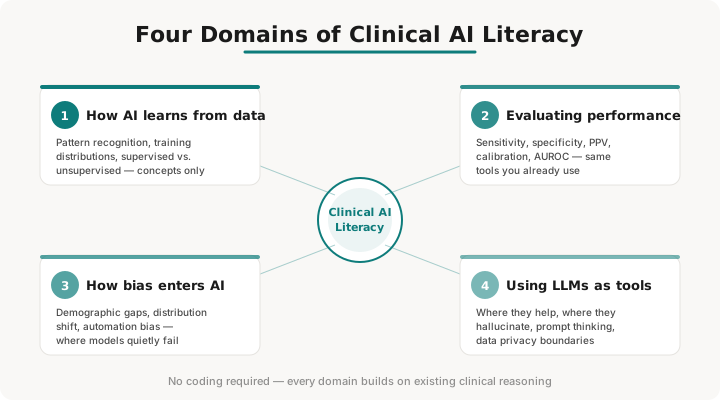
The core of clinical AI literacy is not a coding skill or a technical certification. It is a set of conceptual frameworks — the same kind of frameworks that allow a clinician to read a diagnostic test paper and understand whether its findings apply to their patient population.
Training data: the population the AI learned from. Every AI model is a compressed representation of the data it was trained on. If a diagnostic algorithm was trained on imaging data from tertiary referral centres in high-income countries, it has learned to recognise disease patterns as they present in that population — with the imaging equipment used there, in patients who reached that level of care. A clinician deploying that tool in a different setting needs to ask: is this population like mine? Were the images acquired the same way? What diseases were prevalent in the training data that may not be prevalent here?
This question — what population did this AI learn from? — is the most important question a clinician can ask. It has a direct analogue in clinical epidemiology: asking whether a drug trial’s population is comparable to the patient in front of you. The clinical instinct to ask this question is already there. It needs to be applied to AI.
Reading an AI validation study. The skills required to evaluate an AI performance study are, to a meaningful degree, the skills already used to evaluate a diagnostic test paper. Sensitivity and specificity, positive and negative predictive values, area under the ROC curve — these metrics apply to AI classification systems in the same way they apply to any diagnostic test. Understanding how to interpret these metrics in the context of AI validation is one of the most practical skills a clinician can build.
What matters additionally for AI is external validation: has the model been tested on data from a different institution than the one it was trained on? A model that performs well only in its derivation dataset is almost certainly overfitting — it has learned specific features of one dataset rather than generalisable clinical patterns. The CONSORT-AI reporting guidelines were developed specifically to ensure that AI clinical studies report the information clinicians need to make this evaluation.
Automation bias. Research in cognitive psychology has documented a consistent tendency: when people receive a recommendation from an algorithmic system, they weight it more heavily than equivalent advice from a human — and they are less likely to notice when it is wrong. This is automation bias, and it has been demonstrated in medical contexts specifically. Radiologists shown AI-flagged findings are more likely to agree with the AI even when the AI is incorrect. Clinicians receiving algorithmic risk scores anchor on the number in ways that are not always justified by the underlying model’s precision.
Automation bias is not a character flaw. It is a documented cognitive pattern that emerges when humans interact with systems that appear authoritative and consistent. The defence against it is awareness — knowing it exists — and maintaining active clinical reasoning rather than passive algorithmic deference.
Awareness of automation bias does not mean dismissing AI tools. It means maintaining the habit of independent clinical reasoning alongside them. The AI deterioration score should prompt a clinical assessment, not replace it.
Ethics and bias: what the AI inherited from its data. AI systems inherit the biases present in their training data. This is not a political statement — it is a technical fact with clinical consequences.
The most cited example in clinical AI involves dermatology. Multiple studies have found that AI skin lesion classifiers perform significantly worse on darker skin tones than on lighter skin tones, because the training datasets contained predominantly lighter-skinned patient images. The model learned what skin cancer looks like in that population. Applied to a patient with darker skin, it is extrapolating beyond its training distribution — and its performance degrades.
This pattern recurs across specialties. Cardiovascular risk models trained predominantly on Western populations may not reflect the risk factor distributions of other populations. Radiology algorithms trained on images from high-income settings may not account for atypical disease presentations more common elsewhere. Clinical risk scores trained in tertiary hospitals do not automatically generalise to community settings.
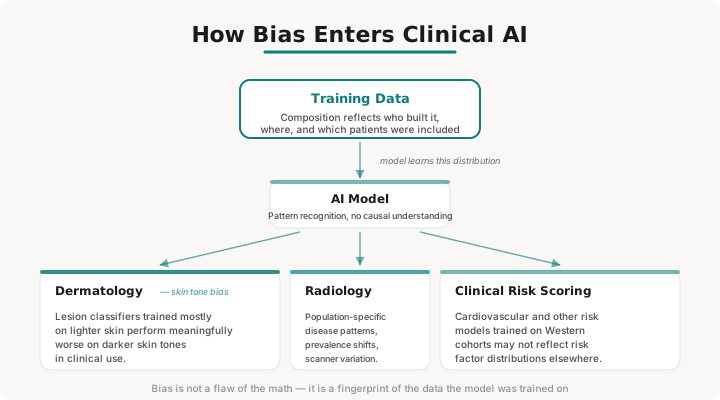
The clinician’s response to this is not to refuse AI tools — it is to ask the question: was my patient population represented in this training data? If the honest answer is no, or I don’t know, that should inform how much weight to place on the AI’s output.
Prompting and LLMs: a new category of clinical tool. Large language models — the technology behind ChatGPT, Gemini, and similar systems — are now a reality in clinical workflows, whether medical institutions have formally acknowledged them or not. Clinicians are using them to draft patient letters, summarise literature, and generate differential diagnosis lists. Some are using them for pharmacology questions.
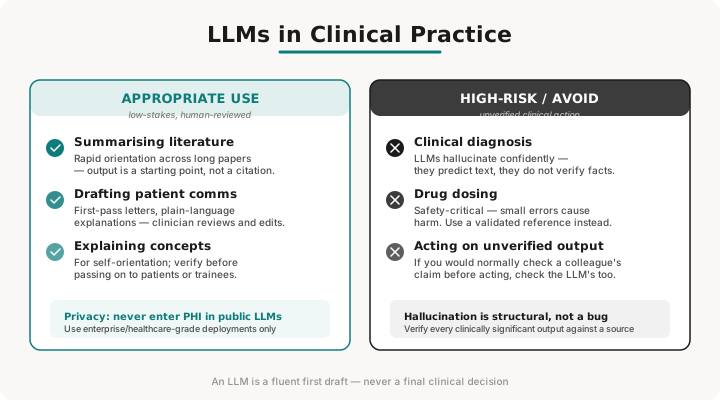
Using LLMs effectively as clinical tools requires understanding something fundamental about how they work: they generate text by predicting what word is most likely to follow the previous words, based on patterns learned from a vast training corpus. They do not retrieve facts from a database. They do not verify what they write. This is why LLMs “hallucinate” — produce fluent, confident, completely incorrect statements — and why this hallucination is not a bug being fixed but a structural feature of the technology.
A large language model is like a very well-read colleague who can synthesise and explain almost anything convincingly — but who hasn’t necessarily checked whether what they’re saying is accurate. The output looks authoritative. It requires verification.
LLMs are genuinely useful for tasks where the cost of an error is low and the output is being reviewed by a knowledgeable human: drafting first-pass patient communications, explaining concepts in plain language, summarising long papers for rapid orientation. They are genuinely dangerous for tasks where accuracy is safety-critical: drug dosing, clinical diagnosis, and any decision where the clinician would act directly on the AI’s answer without independent verification.
The other critical issue with public LLMs — ChatGPT and its equivalents — is data privacy. Patient-identifiable information must never be entered into a public LLM. These inputs may be retained and used in model training. Healthcare-specific deployments with appropriate data agreements exist, but the consumer versions do not provide the protections required for clinical data.
The Professional Responsibility Argument
A doctor is expected to understand the basis for a blood test result — not just the number, but what the test measures, what can cause a false positive, and how it relates to the clinical picture. This expectation is not onerous. It is what it means to use a diagnostic tool as a professional rather than as a passive recipient of outputs.
The same expectation is forming around AI. Clinicians who use AI tools without understanding their basis — who accept AI-generated risk scores without asking how the model was validated, who deploy AI diagnostic support without knowing whether the training population resembles their patients — are in the same position as a clinician who orders a test without understanding what it measures.
The World Health Organization’s guidance on AI in health explicitly frames AI literacy as a professional competency for the health workforce — alongside technical developers, regulators, and health system managers. The framing is deliberate: AI in health is not a technical speciality to be left to informaticians. It is a clinical domain that clinicians need to engage with as professionals.
This does not mean every clinician needs to become a data scientist. It means every clinician needs to be able to ask the right questions about AI tools they use — the same way they ask the right questions about any clinical tool.
The Position Every Clinician Should Take
This article does not end with an optimistic forecast about AI transforming medicine. That forecast may be correct, but it is not what matters most right now.
What matters most right now is agency. The doctors who engage with AI critically — who read the validation studies, who ask about training populations, who advocate for ethical deployment, who maintain their clinical reasoning alongside algorithmic recommendations — are not just protecting their patients. They are shaping how this technology lands in clinical practice.
Clinical AI is not arriving in a finished form. It is being built, deployed, evaluated, and revised in real time. The clinicians who are in the room when those decisions are made — who can articulate what a model’s validation study does and does not show, who can identify when an algorithm’s training data does not reflect their patient population — are the ones who will influence whether AI improves clinical care or simply adds a new layer of opacity to it.
Passive observation is not a neutral stance. The space that clinicians leave unoccupied in AI development and governance will be filled by others — by commercial vendors, engineers, and administrators pursuing legitimate interests that are not the same as clinical judgment.
The place to start is not a technical course. It is the questions in this article. Applied to the next AI tool a clinician encounters — what did it learn from? Who validated it? Does its training population look like my patients? — they constitute the beginning of a genuinely informed clinical relationship with AI.
That is what AI literacy looks like in practice. And it is entirely within every clinician’s reach.
Explore the MedAI Collective resource library for more on AI in clinical practice. For a deeper treatment of how to read AI validation studies, see our guide on biostatistics and AI performance metrics. For practical guidance on using LLMs in clinical workflows, see Prompt Thinking for Clinicians.