Most doctors in India will encounter clinical AI not through a training programme or an informed procurement discussion, but through a vendor demo in a conference room, followed by an email from administration announcing that the tool has been acquired. By the time the AI system appears in the clinical workflow, the decision has already been made. The doctor is left with a tool they did not choose, training they did not receive, and accountability they did not agree to.
This pattern is not unique to a single hospital or specialty. It is the dominant model of clinical AI adoption across India today — and it is producing exactly the outcomes you would expect. Tools are used inconsistently. Failure modes go unreported. Procurement committees buy the demo, not the deployment. And the doctors who will actually use these systems in daily practice remain, in the language of policy documents, “key stakeholders” who are consulted last.
This article is written for the doctor who wants to understand AI for doctors in India on their own terms — not the hype version, not the fear version, but the practical clinical reality. What AI tools actually do. Where they work in Indian hospitals and where they stall. What the doctor’s specific responsibilities are when AI enters the department. And what kind of knowledge a clinician actually needs to engage meaningfully with this technology — without learning to code.
What Clinical AI Actually Is — and Isn’t
The first thing a doctor needs to understand about clinical AI is that there is no such thing as a general-purpose medical AI. Every clinical AI tool deployed in an Indian hospital today is a narrow AI system: it was trained to perform one specific task, on one specific type of data, within a defined clinical context. It does that task well, sometimes better than human experts. It does nothing else.
This distinction matters enormously because most of the public discourse about AI in medicine conflates narrow AI with general AI — the hypothetical system that reasons flexibly across domains the way a doctor does. Narrow AI cannot reason. It recognises patterns. An AI tool that detects tuberculosis on chest X-rays has learned to associate certain pixel patterns in radiographic images with TB findings. It has no understanding of what tuberculosis is, no ability to consider the patient’s travel history, no clinical judgment about the prior probability of disease in this particular patient. It outputs a probability score. The clinical decision remains with the doctor.
Clinical AI does not replace the doctor’s judgment — it adds one more data point to the clinical picture. The doctor’s responsibility is to understand what kind of data point it is, how reliable it is, and when to override it.
The second critical concept is the difference between decision support and decision replacement. Clinical AI tools are legally and ethically designed as decision support — they inform the clinician’s decision, they do not make it. The CDSCO’s evolving framework for Software as a Medical Device (SaMD) in India reflects this: AI diagnostic tools are classified and regulated as medical devices that assist the clinician, not replace clinical judgment. The legal accountability for any clinical decision made in the presence of AI output still sits with the treating doctor.
Understanding this changes how a doctor should engage with an AI tool. The question is not “does the AI say yes or no?” The question is “what evidence is this AI output based on, how reliable is that evidence for patients like mine, and how should it update my prior assessment of this case?”
Where AI for Doctors Is Already Working in Indian Hospitals
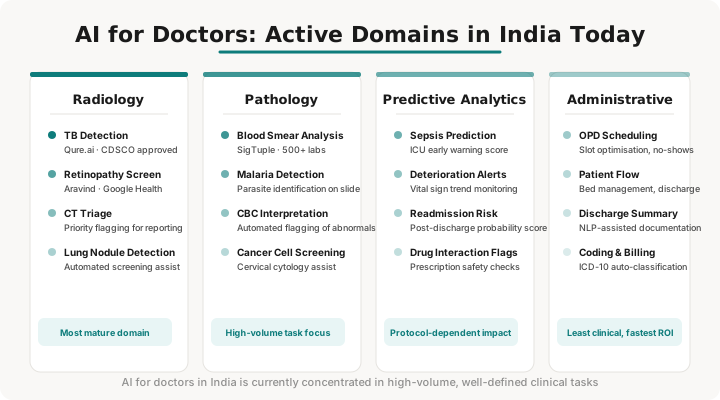
Clinical AI in India is not evenly distributed. It has concentrated in specific specialties, specific hospital types, and specific clinical tasks where the combination of high imaging volume, well-defined decision points, and available training data made algorithmic approaches tractable. Understanding where it works — and the specific reasons it works there — helps a doctor assess how likely AI adoption is to succeed in their own department.
Radiology remains the most advanced domain. India carries the highest tuberculosis burden of any country in the world, and this reality has driven the deployment of AI-powered chest X-ray analysis tools at a scale that is genuinely impressive. Qure.ai’s qXR product, which detects abnormalities on chest radiographs including TB findings and lung nodules, has received CDSCO approval and has been deployed across government TB screening programmes and private hospital chains in partnership with the National TB Elimination Programme. The system has been validated on Indian patient populations, which is a critical distinction from many AI tools that enter the Indian market having been trained primarily on Western imaging datasets. A 2023 study in partnership with the programme reported sensitivity figures comparable to radiologist performance for triaging X-rays in high-volume screening contexts — though the comparison conditions and patient population specifics matter considerably when interpreting those numbers. [For a detailed analysis of where radiology AI succeeds and stalls in India, see our piece on why radiology AI works in Tier 1 hospitals but stalls everywhere else.]
Ophthalmology has produced some of India’s most celebrated AI deployments. Aravind Eye Hospital in Madurai — which performs more cataract surgeries than any other facility in the world — partnered with Google Health to validate AI-based diabetic retinopathy screening on Indian patient data. The collaboration, published in Nature Biomedical Engineering, demonstrated high sensitivity for detecting referable diabetic retinopathy in a population where the disease burden is substantial and the specialist-to-patient ratio is deeply unfavourable. Remidio, a Bengaluru-based company, has built portable fundus cameras with integrated AI that allow primary healthcare workers in tier-2 and tier-3 settings to conduct retinopathy screening without a specialist on-site.
Pathology has seen SigTuple emerge as a notable Indian example. The Bengaluru company’s AI-powered blood smear analysis platform — used for complete blood count interpretation, malaria parasite detection, and abnormal cell flagging — has been deployed across several hundred diagnostic laboratories and hospital settings. The clinical value is in high-volume, repetitive analysis tasks where human fatigue and throughput constraints create genuine quality risks.
Predictive analytics is a growing domain in intensive care settings. Sepsis prediction models that analyse vital signs, laboratory values, and nursing documentation to flag patients at risk of clinical deterioration have been deployed in several large Indian hospital chains. These systems do not diagnose sepsis — they generate an early warning score that prompts clinical review. Their value depends entirely on whether clinical teams have the protocols and bandwidth to act on those alerts in a timely way.
Where Clinical AI Fails — and Why Every Doctor Must Understand This
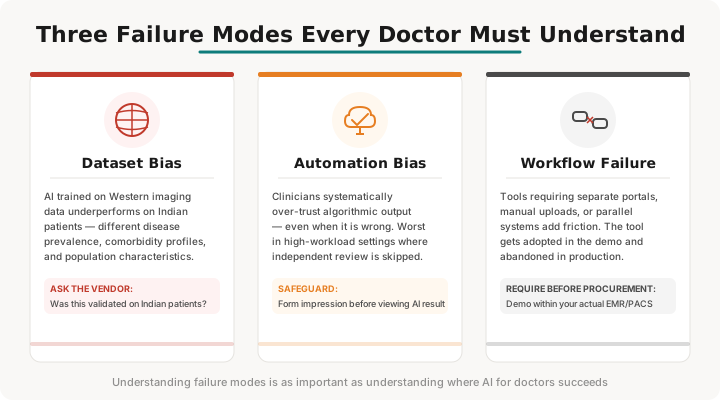
The failures of clinical AI are as instructive as its successes, and a doctor who understands only the success cases is poorly equipped to use these tools safely.
Dataset bias is the most structurally significant failure mode. AI tools learn from the data they are trained on, which means they perform best on populations that resemble their training data. Many AI systems that enter the Indian market were developed and validated primarily on datasets from the United States, the United Kingdom, or Europe. The clinical implications are not hypothetical. Research published in journals including JAMA Dermatology has documented that dermatology AI trained predominantly on lighter skin tones shows meaningfully lower sensitivity for detecting lesions on darker skin. Chest X-ray algorithms trained on North American populations may not account for the prevalence of post-tubercular sequelae and silicosis patterns common in Indian patients. Retinal imaging tools validated in European diabetic populations may not generalise to the clinical spectrum of diabetic retinopathy seen in Indian patients, where disease presentation, severity at first presentation, and comorbidity profiles often differ significantly.
The practical question for any doctor evaluating an AI tool is not “does this tool work?” but “does this tool work for patients like mine?” The answer requires looking at the validation studies — their geographic origins, the demographic characteristics of the study populations, and whether Indian-specific validation data exists.
Automation bias is a failure mode that exists not in the algorithm but in the doctor using it. A systematic review published in the Journal of the American Medical Informatics Association documented that clinicians — like most people — have a systematic tendency to over-trust algorithmic recommendations, even when those recommendations are incorrect. This is automation bias: the cognitive shortcut that treats the AI output as a prior and unconsciously discounts contradictory evidence from the clinical presentation. It is most dangerous in high-workload contexts — exactly the settings where AI tools are most often deployed. A radiologist reviewing two hundred chest X-rays in a shift and using an AI triage tool is at genuine risk of accepting the AI’s flagging decisions without sufficient independent review, particularly for the cases the AI rates as low priority.
Understanding automation bias does not mean rejecting AI tools — it means building workflows that preserve independent clinical assessment rather than replacing it. The AI output should be visible after the doctor has formed their initial impression, not before.
Workflow integration failures account for a significant proportion of AI deployments that stall or are abandoned after initial deployment. An AI tool that requires the doctor to log into a separate portal, manually upload images, wait for results, then cross-reference those results with the primary clinical system is not a workflow improvement — it is additional friction. The clinical AI tools that achieve sustained adoption are those integrated directly into the doctor’s existing working environment: the PACS worklist, the EMR, the reporting interface. This integration is technically complex and institutionally demanding, which is why it happens reliably at well-resourced tier-1 hospital chains and inconsistently everywhere else.
The failure mode that is most damaging to clinical AI adoption is not technical malfunction — it is successful deployment of a tool that nobody uses because it doesn’t fit the workflow.
The Doctor’s Role When AI Enters the Department
The most consequential choice a doctor can make when AI arrives in their department is whether to be a clinical champion or a passive bystander. These are not equally available options — they are choices with different outcomes for the doctor, the department, and the patients.
The clinical champion is not the person who enthusiastically endorses every AI tool that arrives in the hospital. The clinical champion is the person who asks the right questions before procurement, provides structured feedback during deployment, documents failure modes as rigorously as successes, and sets the standard for how the technology is used in daily practice. This role requires no technical training in AI or machine learning. It requires clinical judgment applied to a new category of clinical tool.
The specific questions a doctor should ask before an AI tool is deployed in their department are well-established. Does the tool solve a clinical problem that actually exists in this department, or a problem that looks good on a vendor slide? Has it been validated on Indian patient populations? What are its failure modes, and how are those surfaced to the clinician? Who is responsible when the AI is wrong — and what does the vendor’s indemnity clause actually say? [A detailed framework for evaluating AI tools before hospital procurement is available in our guide on the seven questions every clinician should ask.]
The medicolegal dimension of clinical AI in India remains in active development. CDSCO’s Software as a Medical Device framework establishes that AI diagnostic tools are regulated devices — which implies a chain of responsibility that includes the manufacturer, the healthcare facility, and the treating clinician. Under current Indian medical law, the treating doctor retains accountability for clinical decisions made in their name, regardless of whether those decisions were supported by an AI tool. “The AI said so” is not a legal defence, and it is not a clinical defence either. The doctor who uses an AI tool without understanding its limitations is accepting accountability for errors they may not have the information to prevent.
The Regulatory Landscape Every Doctor Should Know
India’s regulatory framework for clinical AI is developing faster than most practitioners realise. Three regulatory instruments are directly relevant to AI for doctors practising in India today.
CDSCO and Software as a Medical Device: The Central Drugs Standard Control Organisation has been developing regulations for AI-based software that meets the definition of a medical device. Under the Medical Devices Rules 2017, software intended for diagnosis, prevention, monitoring, treatment, or alleviation of disease can be classified as a medical device. AI diagnostic tools — systems that generate a clinical recommendation based on patient data — fall into this category. The practical implication for doctors is straightforward: if an AI tool your hospital is deploying does not have CDSCO approval or clearance, the hospital is carrying regulatory risk, and you should ask why.
The Digital Personal Data Protection Act (DPDP Act) 2023: The DPDP Act, India’s primary data protection legislation, has direct implications for how clinical data is used in AI systems. Patient data used to train, validate, or run an AI tool is personal data under the Act. The consent requirements for secondary use of clinical data — including use in AI model training — are meaningful and have not been consistently addressed by hospital AI procurement processes. Doctors who are asked to participate in AI data collection projects, or whose department’s historical data is being used to train an AI system, have a legitimate interest in understanding whether the relevant patient consent requirements have been met.
ABDM and Interoperability: The Ayushman Bharat Digital Mission’s shift to mandatory FHIR-based data exchange has significant implications for clinical AI. ABDM-compliant electronic health records create longitudinal patient data that, in principle, makes more sophisticated AI applications possible — predictive risk scoring across care episodes, AI-assisted care coordination, and population health analytics. The ABDM compliance requirements that hospitals are now implementing are building the data infrastructure on which the next generation of clinical AI will run. The full implications of ABDM 3.0 for clinical practice are covered in our analysis of the new interoperability rules.
The National Medical Commission has also issued guidelines emphasising that digital health tools, including AI systems used in medical education and clinical training, must meet standards of clinical evidence comparable to those applied to other medical interventions. This framing — AI as an intervention, not just a tool — is the correct clinical lens. It also aligns with the NITI Aayog’s National Strategy for Artificial Intelligence, which specifically identifies healthcare as a priority sector and calls for AI systems to be validated on Indian population data before deployment.
Building AI Literacy as a Doctor in India
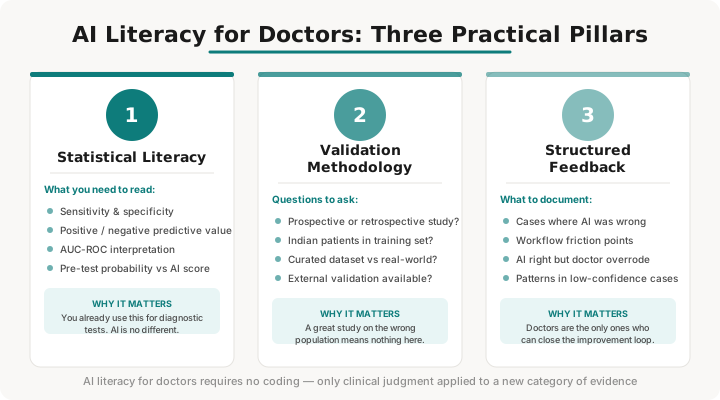
The knowledge a doctor needs to engage effectively with clinical AI is not technical. It does not require understanding how neural networks are trained, how gradient descent works, or how to interpret a receiver operating characteristic curve. What it requires is a specific kind of clinical literacy: the ability to ask the right questions about evidence, validation, and failure modes.
Statistical literacy is the most relevant foundation. Sensitivity, specificity, positive and negative predictive value, and the distinction between accuracy in a balanced test set versus accuracy in a clinical population with real disease prevalence — these are concepts every doctor encounters in clinical training and applies to diagnostic test interpretation. Clinical AI performance is reported in exactly the same terms. A doctor who can read a diagnostic test validation study can read an AI validation study. The key difference is understanding that AI performance is population-specific in ways that conventional diagnostic tests often are not: an AI tool validated in one patient population may perform very differently in another. The SPIRIT-AI and CONSORT-AI guidelines, published in Nature Medicine, provide a checklist of what a credible AI clinical trial report should contain — a useful reference for any doctor evaluating vendor-supplied evidence.
Validation methodology is the second essential area. The critical question for any AI tool is: how was it tested, and does the test resemble the conditions in which it will be deployed? A retrospective validation on a curated dataset of high-quality images collected at a single tertiary centre tells you very little about how the tool will perform on the variable-quality images produced by an older CT scanner in a district hospital. Prospective validation in real deployment conditions, at institutions comparable to the one considering adoption, is the gold standard. Most AI tools do not have this kind of evidence. That is not automatically disqualifying, but it should inform how confident the department is in deploying the tool and what safeguards should be in place.
Structured feedback is perhaps the most underutilised form of clinical AI literacy. Doctors who use AI tools are in the best position to document failure modes — cases where the AI output was wrong, cases where it was right but for the wrong reasons, cases where it created workflow friction rather than reducing it. This structured clinical feedback is what makes AI tools better over time. It is also the mechanism by which the doctor exercises genuine influence over how the technology develops in their department. Most hospitals do not have a formal channel for this kind of feedback. Advocating for one is a practical contribution that any doctor can make.
The Clinician’s Advantage in the AI Era
There is a version of the AI-in-healthcare narrative in which doctors are passive recipients of technology they do not understand, managed by administrators who see efficiency gains on a spreadsheet, sold tools by vendors whose primary accountability is to their investors. That version is playing out in some hospitals today.
There is another version, in which clinicians who understand AI for doctors in India well enough to ask the right questions become the people who shape how it is adopted — setting the evaluation criteria for procurement, designing the workflows that make AI tools clinically useful rather than technically impressive, and establishing the standards for how failure modes are documented and addressed.
The doctors who will lead the next decade of Indian healthcare are not necessarily the ones who can build an AI model. They are the ones who can read a validation study critically, identify the clinical gap an AI tool actually solves versus the clinical gap it is marketed to solve, and make the medicolegal and ethical implications of clinical AI legible to their institutions.
That knowledge is accessible. It does not require a computer science degree or a machine learning course. It requires the same analytical rigour that medicine has always demanded — applied to a new category of clinical evidence, produced by a new category of tool, with implications that every practicing doctor in India will encounter, whether they seek them out or not.
MedAI Collective works with doctors, hospitals, and healthtech companies across India on clinical AI adoption, evaluation, and strategy. The Practitioner Briefing is a structured session for clinicians who want to build the working knowledge to engage with clinical AI on their own terms.